RSVP: Step-by-Step (2027)
By zainzari • Published October 22, 2026 • Updated October 22, 2026
 📌 Save
To RSVP to a wedding: check who is named on the envelope, decide promptly, then complete the paper card or website form in full — attendance, names, meals and dietary needs — and return it well before the deadline. This step-by-step guide covers paper, online and tricky situations like plus-ones and late changes.
Weddings in 2027 blend old courtesies with new logistics — websites, online RSVPs, unplugged ceremonies and zero-proof celebrations. This guide keeps the timeless parts, updates the rest, and writes it all for real guests in the USA, UK and Canada.
Work through the 25 rules before your next wedding and you will arrive calmer, dress righter and celebrate better — while the couple simply enjoys having you there.
At a Glance: Rule, Area & Priority
| # | Rule | Area | When It Matters | Priority |
|---|---|---|---|---|
| 1 | Step 1: Read the Envelope First | Paper card | Mail same day | Classic |
| 2 | Step 2: Check the Date, Deadline and Website | Website form | To confirmation screen | Modern standard |
| 3 | Step 3: Decide Promptly and Honestly | Plus-one | Full name required | Always |
| 4 | Step 4: Find Your RSVP Method | Decline | Same speed as yes | Warm & brief |
| 5 | Step 5: Write Names Exactly as Invited | Change of plans | Immediately | Once, complete |
| 6 | Step 6: Mark Attendance Clearly | Paper card | Mail same day | Classic |
| 7 | Step 7: Choose Meals for Every Guest | Website form | To confirmation screen | Modern standard |
| 8 | Step 8: Note Real Dietary Requirements | Plus-one | Full name required | Always |
| 9 | Step 9: Name Your Plus-One in Full | Decline | Same speed as yes | Warm & brief |
| 10 | Step 10: RSVP for Children by Name and Age | Change of plans | Immediately | Once, complete |
Priority guide: work through the essential rules first — they cover the moments couples remember most. Full guidance for all 25 rules is below.
Step 1: Read the Envelope First
 📌 Save
Your RSVP starts before any card: the envelope names exactly who is invited. Note whether a partner is named, whether ‘and Guest’ appears, and whether children are listed — everything you write later must match this list precisely, because the couple built their count, budget and seating universe from these names alone.
Step 2: Check the Date, Deadline and Website
 📌 Save
Find three facts immediately: the wedding date, the RSVP deadline printed on the card, and the wedding website address. Enter the date in your calendar, set a reminder a week before the deadline, and open the website once now — most questions you would otherwise ask the couple are already answered there in black and white.
Step 3: Decide Promptly and Honestly
 📌 Save
Decide with your real calendar, budget and energy in view — not with hope as a strategy. Check travel costs, work commitments and childcare feasibility before answering, because a researched yes is a reliable yes. If the honest answer is no, deciding that now is a kindness: waitlisted guests and caterers both benefit from your early clarity.
Step 4: Find Your RSVP Method
 📌 Save
Couples specify the method: a paper card with a stamped envelope, a website form, or occasionally both for different events. Use the method given — do not substitute a casual text for a requested card, because the couple’s tracking system (a spreadsheet, a planner, a pile of cards) is built entirely around the channel they chose for two hundred replies.
Step 5: Write Names Exactly as Invited
 📌 Save
On the card or form, write the full names of attending guests exactly as they should appear — this spelling flows directly into place cards, seating charts and the caterer’s list. Use the name you actually go by if it differs from the formal one, spelled clearly; couples would rather print ‘Sam Rivera’ correctly than guess from an initial.
Step 6: Mark Attendance Clearly
 📌 Save
Tick, circle or select accepts/regrets so clearly that a tired couple at midnight cannot misread it. Ambiguous marks — a tick between boxes, an unmarked card returned in the envelope — are more common than you would think and each one triggers a follow-up message in the busiest week of the couple’s year.
Step 7: Choose Meals for Every Guest
 📌 Save
Select one meal per named guest, matched to the right name — including your plus-one and children where invited. Read the menu descriptions on the website if the card’s single words (‘beef’, ‘vegetarian’) leave you guessing; choosing accurately now prevents the table-level plate swaps that unravel banquet service timing later in the evening.
Step 8: Note Real Dietary Requirements
 📌 Save
Write allergies and genuine requirements in the dietary field in plain words: ‘peanut allergy’, ‘coeliac — gluten free’, ‘vegan’. Distinguish severity where it matters — kitchens triage a nut allergy differently from a preference. This is the one RSVP field that protects health, so completeness and honesty outrank politeness about being ‘no trouble’.
Step 9: Name Your Plus-One in Full
 📌 Save
If your invitation includes a guest, this step is mandatory and specific: full name, correctly spelled, with their meal and dietary information collected from them before you reply. Ask your guest directly rather than guessing their meal — a plus-one discovering their plate at the table is a small failure of hosting on your part, planned weeks in advance.
Step 10: RSVP for Children by Name and Age
 📌 Save
Invited children get individual lines: full name, age (caterers band children’s meals and pricing by age), meal selection and dietary notes. Do not compress three children into ‘the kids’ — the couple is ordering highchairs, activity packs and kids’ meals from your numbers, and precision at this step is what makes the children’s provision look effortless on the day.
Step 11: Decline in the Same Motion
 📌 Save
Declining uses the identical steps: complete the card or form, mark regrets clearly for every named guest, and return it at acceptance speed. Add one warm handwritten line on paper cards — regret plus good wishes — and resist explaining your reasons in detail. A clean, kind, prompt no is a finished task; do not let guilt stretch it into a late one.
Step 12: Return Paper Cards Immediately
 📌 Save
A completed card in your kitchen is not an RSVP — it becomes one in the post. Mail it the day you complete it with the supplied envelope, and allow real postal time: the couple’s deadline is a received-by date in their planning, whatever the postmark romance suggests. International replies should travel the week they are written, not the week they are due.
Step 13: Complete the Entire Online Form
 📌 Save
Website RSVPs run several screens — attendance, meals, dietary, sometimes shuttles and song requests. Finish every screen and reach the confirmation page; partial completions often save nothing or half an answer. Then screenshot the confirmation. If no confirmation appears, assume the reply failed and try again or message the couple — silence in their spreadsheet is indistinguishable from a decline.
Step 14: Answer the Extras That Help
 📌 Save
Song requests, shuttle seats, welcome-party attendance and advice cards are planning inputs disguised as fun. Answer them all in the same sitting: shuttle numbers decide bus sizes, welcome-party counts decide bar orders. Every completed extra is one less assumption in the couple’s final spreadsheet — and possibly one more song you love at midnight.
Step 15: Double-Check Before You Send
 📌 Save
Thirty seconds of review catches ninety percent of RSVP errors: names complete and spelled, attendance marked, one meal per guest, dietary noted, plus-one named, children counted. Compare your reply against the envelope one final time — the two documents should describe exactly the same humans, no more and no fewer, attending the same celebration.
Step 16: Keep Your Own Record
 📌 Save
Note what you replied and when: a photo of the card, a screenshot of the confirmation, a line in your calendar. If a query arises — a lost card, a website glitch — you can answer the couple instantly and accurately instead of reconstructing your intentions from memory during their final-numbers week, when every uncertainty costs them time.
Step 17: Book the Logistics Your Yes Implies
 📌 Save
Sending the RSVP starts your own planning clock: hotel block rooms expire, flights price upward, childcare books out. Reserve travel and rooms within days of accepting, while the couple’s negotiated rates and your preferred options exist. A yes sent in March with logistics attempted in the wedding month is how guests become cancellation statistics in the final week.
Step 18: If Plans Change, Change the RSVP
 📌 Save
Changed job, illness, breakup, new baby: contact the couple the day you know, through the fastest channel, with a brief apology and the complete new answer. One early update is a manageable adjustment; a discovered absence is a paid empty chair and a table of eight set for nine. Earliness is what separates an understandable change from an etiquette breach.
Step 19: Handle the Awkward Cases Cleanly
 📌 Save
Partner uninvited? Attend as invited or decline — do not write them in. Childcare collapsed? Tell the couple early and let them choose. Invitation arrived late or went astray? Reply the day it reaches you and mention the postal adventure briefly so the couple knows their other mail may have wandered too. Every awkward case resolves with speed, honesty and accepting the couple’s ruling.
Step 20: What Not to Write on an RSVP
 📌 Save
Never add uninvited names, request seating companions, negotiate the menu beyond dietary needs, critique the date or venue, or attach conditions (‘coming if the weather holds’). The RSVP is a confirmation instrument, not a correspondence column. Anything beyond attendance, names, meals and dietary belongs in a separate friendly message — or, more often, nowhere at all.
Step 21: Lost Your Card or Link?
 📌 Save
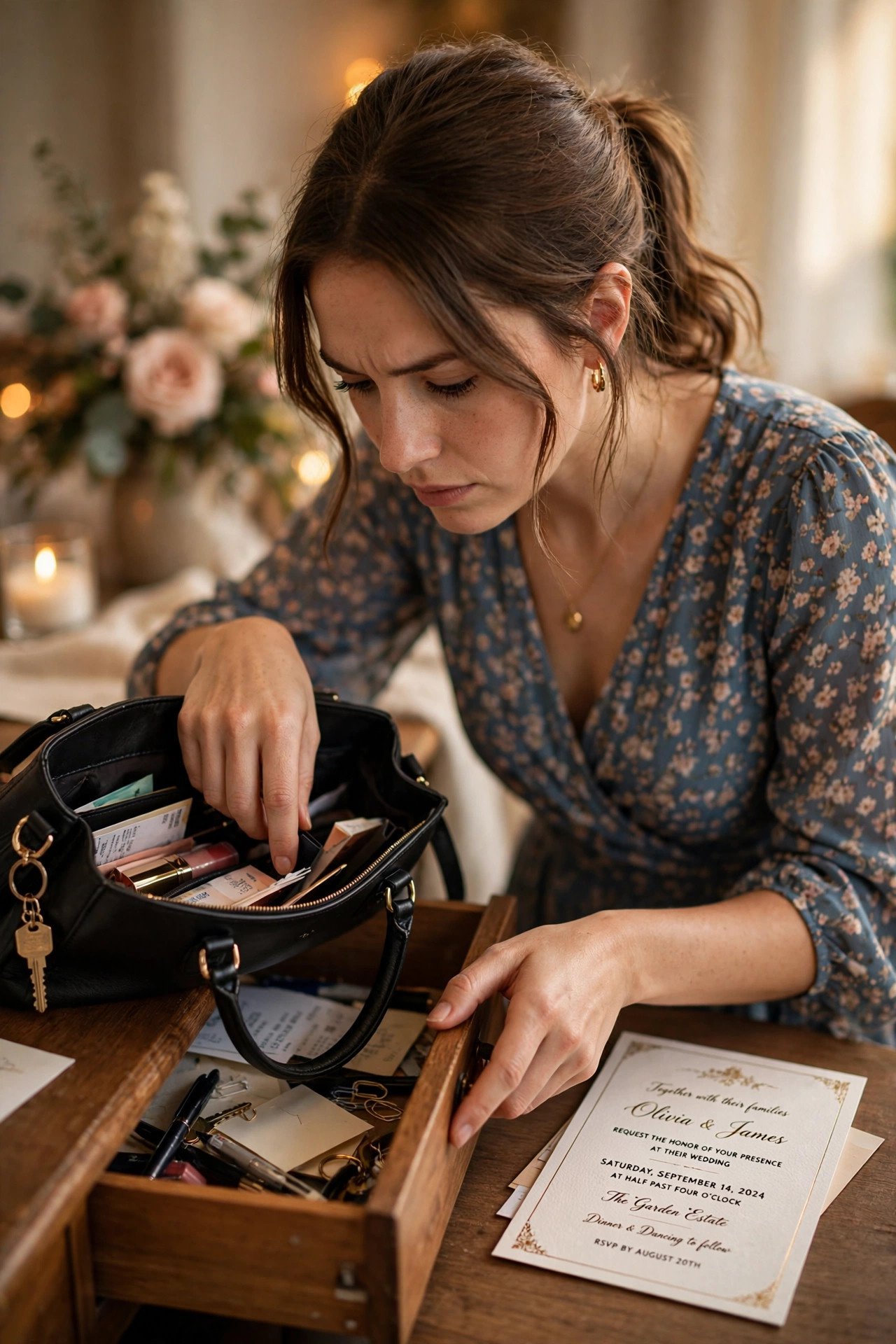
Lost paper card: use the website if one exists, or message the couple once for the link or a replacement — they would far rather re-send a link than chase a silent guest. Lost website address: it is printed on the invitation’s details card and usually searchable from the couple’s names plus ‘wedding website’. Solve it yourself first; ask second; never let a lost card become a missed deadline.
Step 22: RSVP’ing for Someone Else
 📌 Save
Only reply for others within your own invitation unit — your plus-one, your invited children. Adult relatives, grown children and friends must send their own replies; relayed answers get garbled, and a parent accepting for a 26-year-old who cannot attend manufactures exactly the no-show scenario this system exists to prevent. Pass the deadline reminder generously; send the reply never.
Step 23: The Deadline Passed — Act Today
 📌 Save
Overdue is not hopeless: most couples hold a small buffer before final caterer numbers. Reply today, fastest channel, complete answers, one line of apology. Do not compound lateness with a multi-paragraph excuse or a request for special consideration — the fastest possible complete answer is the entire apology a busy couple actually wants to receive at this stage.
Step 24: After Sending — The Quiet Duties
 📌 Save
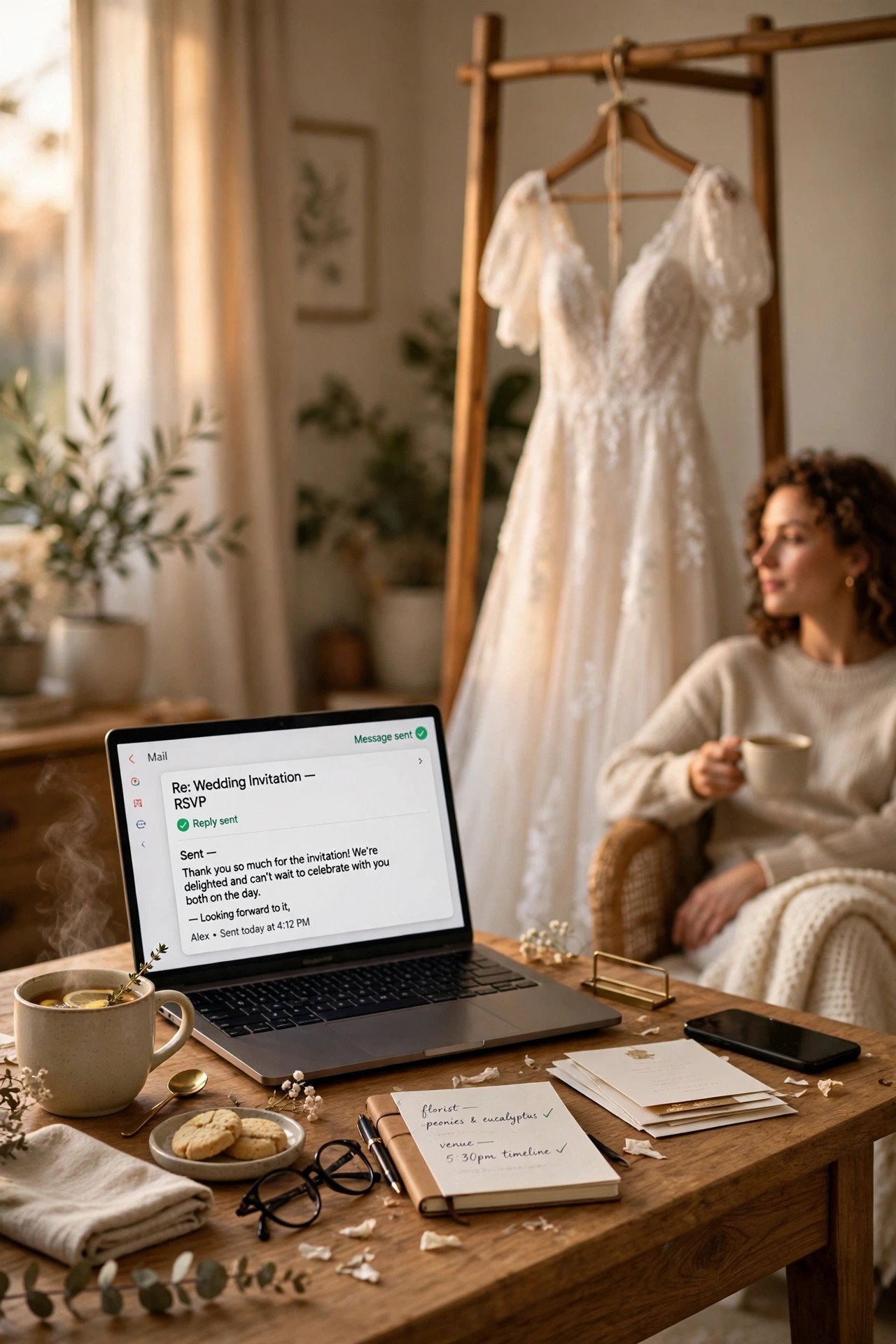
Once sent, your work is done: do not message to confirm receipt repeatedly, ask about seating, or trail the couple for planning details. Trust the system you completed. If the couple needs anything, they will ask — usually in one organized message to all guests near the day with final logistics, parking and timings worth reading the moment it lands.
Step 25: Arrive as the Person Who RSVP’d
 📌 Save
The final step happens at the wedding: be the exact party you promised — same people, on time, ready to celebrate. Every earlier step exists to make this one effortless for the couple: your chair exists, your meal is plated, your name is printed, your children are counted. An RSVP kept perfectly is invisible; an RSVP kept badly is unforgettable. Choose invisible, and enjoy the party you helped plan by answering a card.
RSVP: Step-by-Step (2027) FAQs
What are the basic steps to RSVP to a wedding?+
Check the envelope for who is invited, decide promptly, complete the card or website form in full — attendance, names, meals and dietary needs — then return it well before the deadline and keep a copy or screenshot.
How do I RSVP online to a wedding?+
Use the link or QR code on the invitation, enter your name exactly as invited, complete every screen including meals and dietary fields, and continue until you see a confirmation page. Screenshot it — no confirmation usually means no saved reply.
What do I write on a paper RSVP card?+
Your full name(s), a clear accept or decline mark, one meal choice per guest, any real dietary requirements, and your plus-one’s full name if you have one. Print legibly and post it the same day.
What if I need to change my RSVP?+
Contact the couple immediately with a brief apology and the complete new details. One early change is easily absorbed; changes discovered at the venue — or never communicated — are the ones that cause real problems.
Is it okay to RSVP by text message instead?+
Only if the couple asked for texts. Otherwise use the method they provided — a card or the website — because their tracking system is built around it, and a stray text is easily lost in a busy inbox.
Key Takeaways
- Start from the envelope: reply only for the people named.
- Complete every field — names, attendance, meals, dietary needs.
- Name your plus-one in full and RSVP children individually by age.
- Return paper cards the day you complete them; screenshot online confirmations.
- Changes are forgiven when they are early, single and complete.
Final Thoughts
An RSVP is a five-minute task that carries a two-hundred-person event on its back. Follow the steps in order — envelope, decision, complete reply, prompt return — and you become the guest every couple’s spreadsheet dreams about: counted, catered for, and completely certain to be there.