
12 Wedding Vows I Wish I Would Have Said on Our Wedding Day
By zainzari • Published April 2026 • Updated October 11, 2026
 📌 Save
Writing wedding vows you’ll never regret comes down to craft, not talent: use the 3-part structure (your story, what you love, what you promise), keep them to 1–2 spoken minutes, write specific promises instead of poetry, read them aloud three times, and end with one closing line people will quote. Each lesson below ends with a real “wish I’d said it” example line you can adapt.
Here’s what nobody tells you about wedding vows: the couples who regret theirs almost never regret the sentiment — they regret the writing. Too long. Too vague. Too focused on the past with nothing promised for the future. This isn’t a list of vow styles (we have that elsewhere) — it’s the playbook for writing your own, built from every lesson married couples say they learned too late.
Work through these twelve lessons in order. Each one teaches one piece of the craft and ends with a “wish I’d said it” example line — real, stealable wording that shows the lesson in action. By the end, you’ll have a draft.
At a Glance: Lesson, Focus & When to Use It
| Lesson | Focus | Do It When |
|---|---|---|
| Start with why | Your core reason | Before writing a word |
| 3-part structure | Story → love → promise | First draft |
| 2-minute rule | Length that lands | Editing |
| Promise bank | Stealable vow stems | Stuck moments |
| Specific beats poetic | Details over declarations | Every draft |
| Read aloud ×3 | Delivery rehearsal | Final week |
| Together, then apart | Matching without spoiling | Planning stage |
| Weave in values | Faith & beliefs | Second draft |
| One laugh, max | Humor rationing | Editing |
| Closing line | Memorable finish | Final draft |
| 5 mistakes to skip | What to avoid | Before the ceremony |
| Polish checklist | Final review | Night before |
Each lesson ends with a “wish I’d said it” example line — adapt the wording until it sounds like you.
Start With Why, Not What
 📌 Save
Answer one question first: “Why this person, of all people?” — everything else flows from that answer.
Most vow-writing stalls happen because couples start with the words instead of the reason. Sit down separately and each write one sentence finishing “I’m marrying you because…” — not “because I love you” (that’s the what), but the why underneath it. The calm you bring me. The way you make ordinary days fun. That sentence becomes your vows’ compass; every promise you write should point back to it.
Wish I’d said it: “I’m marrying you because you’re the only person who makes my loudest days quieter and my quietest days funnier.”
Read next: 36 Wedding Vows Ideas: Romantic Personalized Examples
The 3-Part Vow Structure
 📌 Save
Every strong vow follows the same arc: where you started, what you love now, what you promise next.
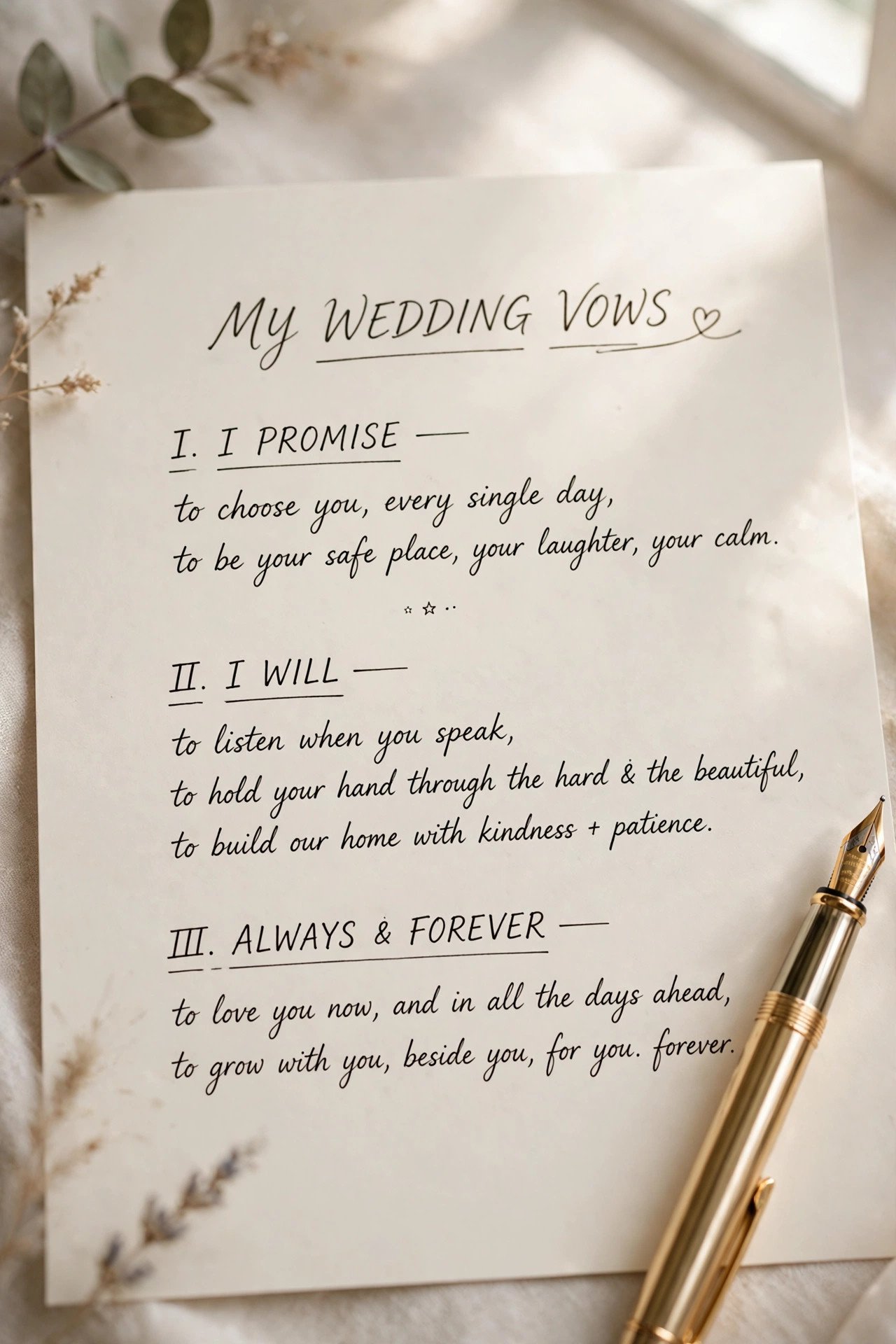
Part one is the story — one memory that captures your relationship, told in two or three sentences. Part two is the present — the qualities you admire in your partner today, stated specifically. Part three is the promise — the vows themselves, starting with “I promise” or “I vow,” aimed at the future. This structure works because it gives guests a journey: they arrive at your promises understanding exactly why you’re making them.
Wish I’d said it: “From that rain-soaked first date to this morning’s coffee, you’ve been my favorite plot twist. I promise to keep choosing you — in the plot twists and the ordinary Tuesdays.”
Read next: How to Write a Funny Mother of the Bride or Groom Speech
The 2-Minute Rule of Length
 📌 Save
If your vows take longer than two minutes to read aloud, cut — emotion has a half-life.
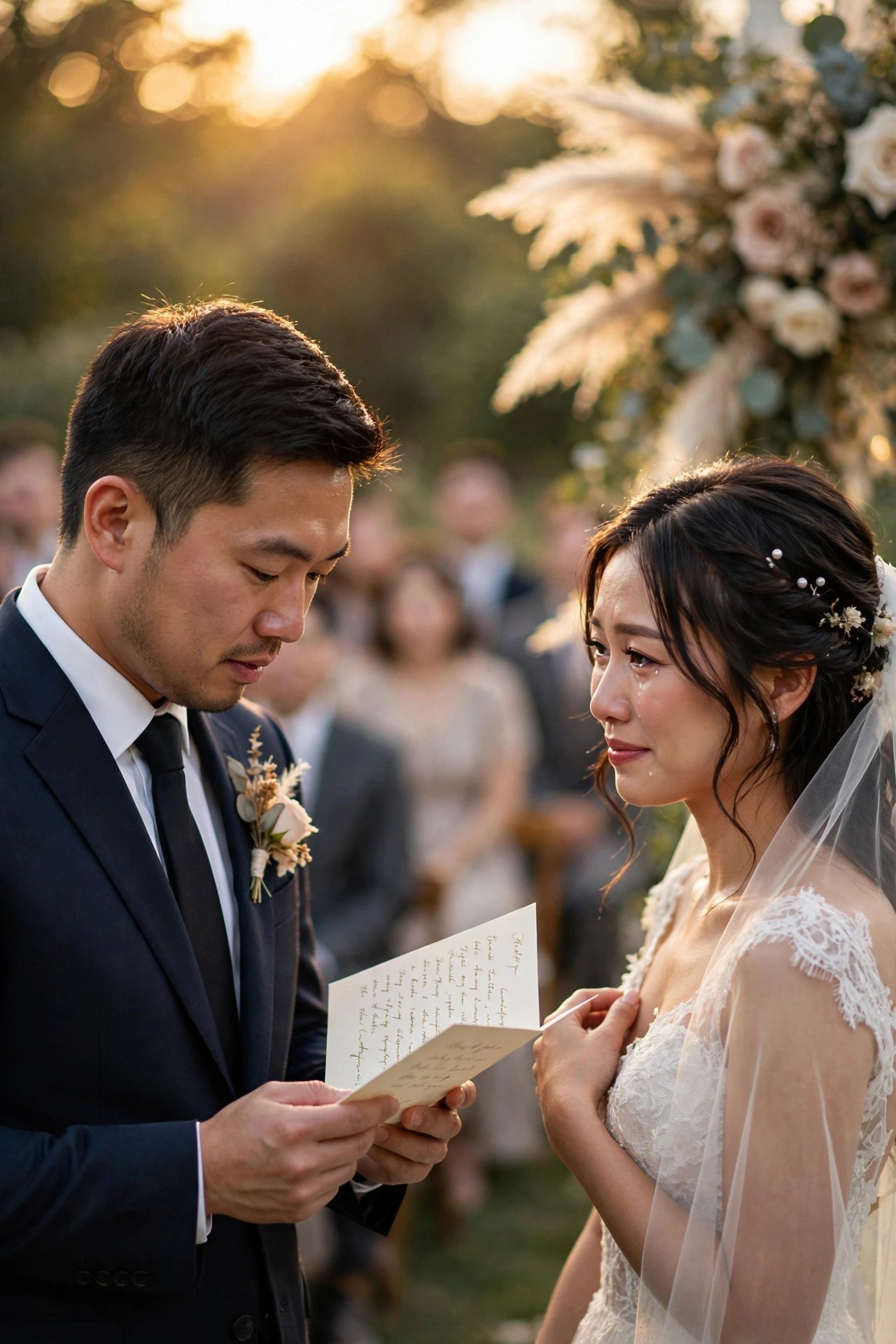
The most common vow regret is length. What feels like a heartfelt five minutes on paper feels like a TED talk at the altar, especially when nerves slow your pace. Aim for 150–250 words — about one handwritten page. Time yourself with a phone; written words take roughly 30% longer to speak than you expect, and pauses for emotion add more.
Wish I’d said it: “I loved you in the sentence it took to meet you. I don’t need five minutes to say what one true minute says better.” (Then prove it — keep it to one true minute.)
Read next: 3 Funny Mother of the Groom Speech Examples
Build Your Promise Bank
 📌 Save
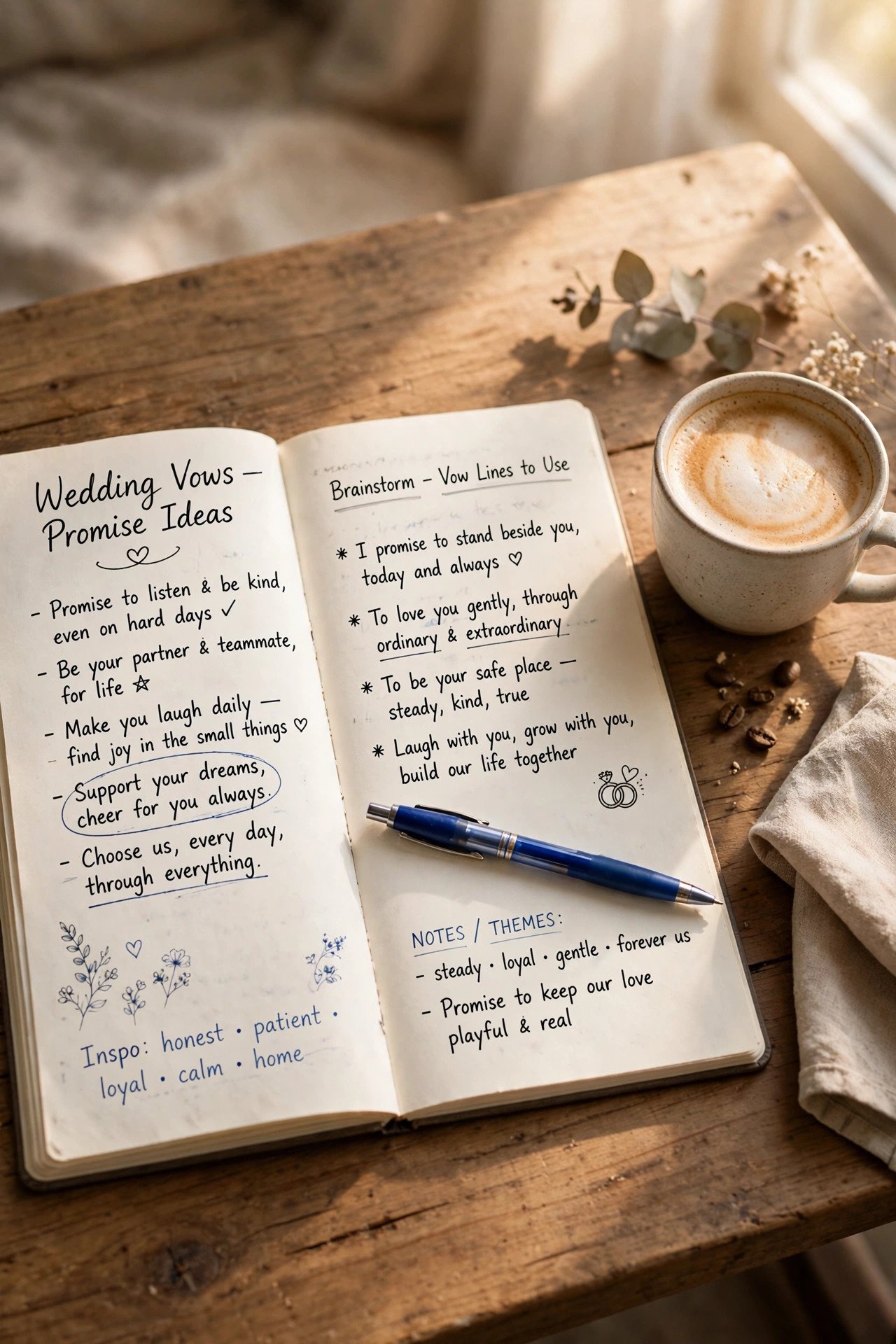
Blank page? Start with these stems: “I promise to…”, “I will always…”, “On the hard days, I will…”, “I choose you when…”
A promise bank is a list of vow-starters you collect before drafting. Write down ten, circle the three that feel most true, and build your vows around those. Good stems: “I promise to laugh with you before I laugh at the situation.” “I vow to be your calm, not your critic.” “I will choose curiosity over judgment when we disagree.” The stems do the heavy lifting — you just make them specific to your relationship.
Wish I’d said it: “I promise to be the person who brings you coffee in the argument, not just after it.”
Read next: Open Letter to My Son on His Wedding Day
Specific Beats Poetic
 📌 Save
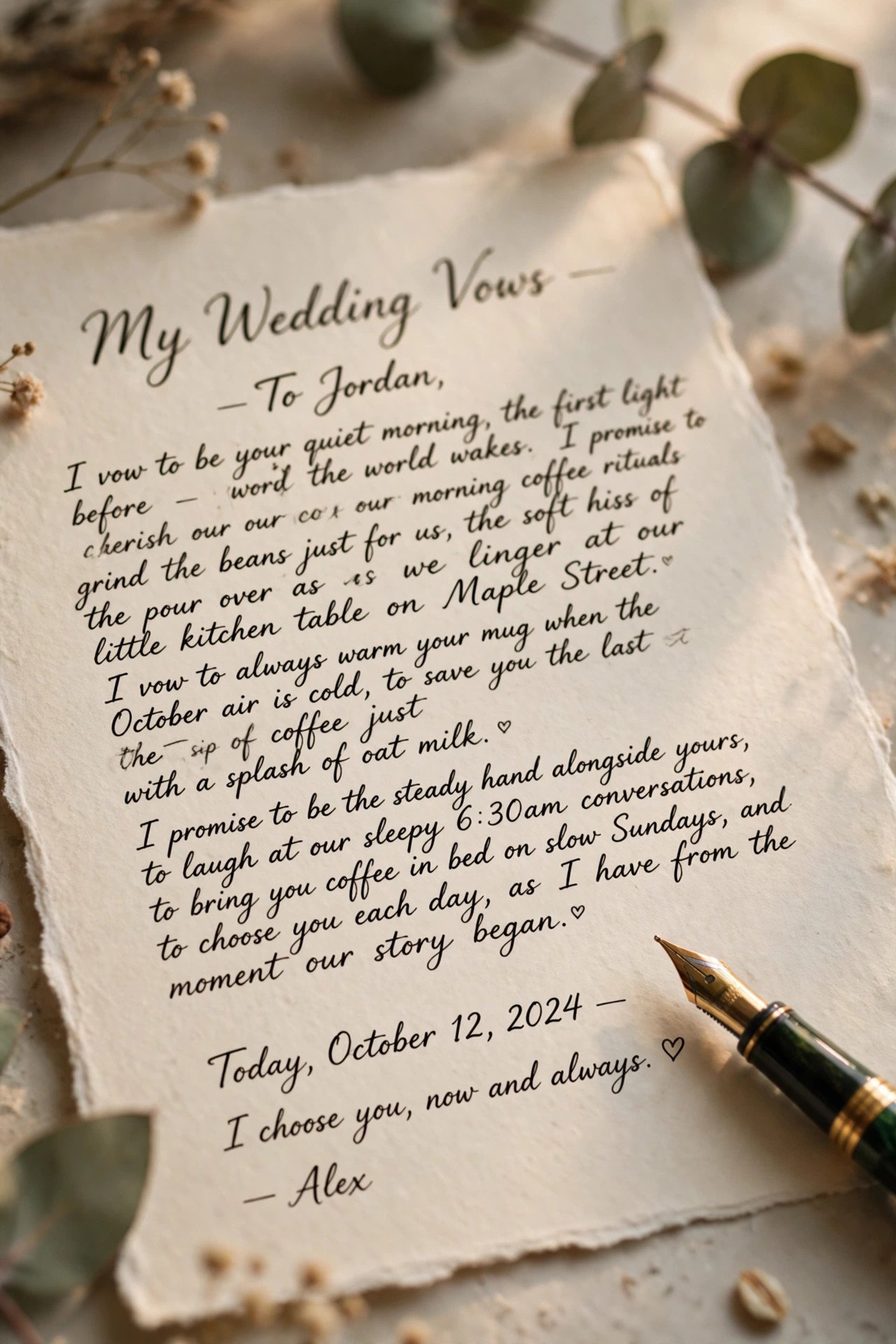
Replace every abstract promise with a concrete one — “your 6am alarms” beats “all of your flaws.”
Vague vows (“I promise to love you forever”) sound like everyone else’s vows. Specific vows (“I promise to pretend your 6am alarm doesn’t wake me, and to mean it most mornings”) sound like YOUR vows. Go through your draft and circle every abstract word — forever, always, everything — and replace at least half with something only you two would say. Guests lean in for specifics; they tune out for poetry.
Wish I’d said it: “I vow to learn your coffee order by heart, to defend your honor in board games, and to never — ever — finish the good snacks without telling you.”
Read next: Letter to Daughter-in-Law: 7 Examples
Read It Aloud Three Times
 📌 Save
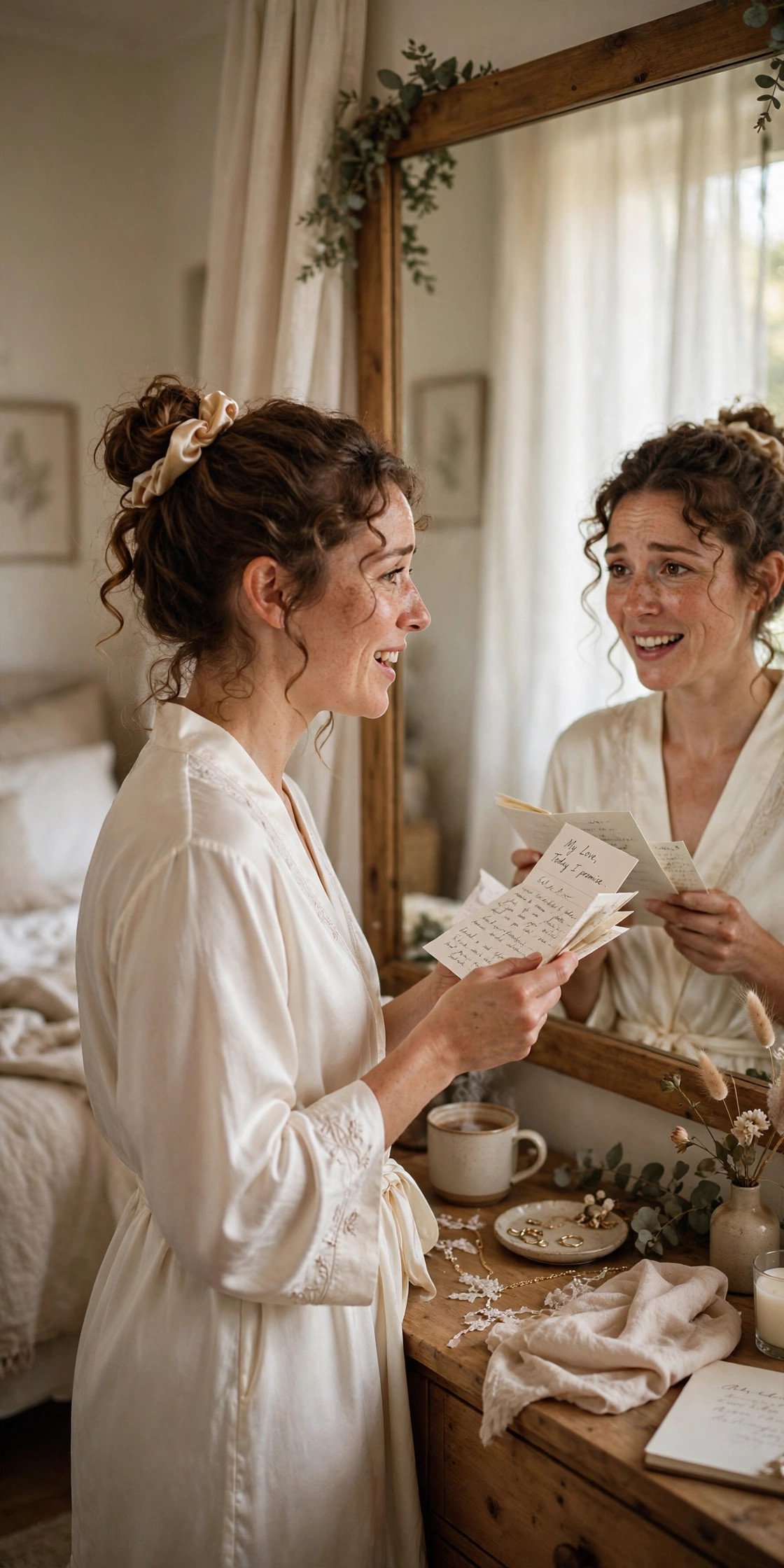
Read every draft aloud — your tongue catches what your eyes forgive: tangled sentences, tongue-twisters, dead spots.
First read-through: mark anywhere you stumble and rewrite it simpler. Second: read to a trusted friend and watch where they smile, tear up, or drift — that’s your audience feedback. Third: read it standing up, at ceremony pace, with pauses — this is your dress rehearsal. Sentences that look elegant on paper often collapse when spoken; the read-aloud is where you find them.
Wish I’d said it: “I’ve practiced saying this three times, and it still catches in my throat — which tells me it’s true.”
Read next: Bridal Shower Speech From the Mother of the Bride
Write Together, Then Apart
 📌 Save
Agree on length, tone and structure together — then write the actual vows in secret.
Nothing deflates a ceremony like one partner’s two-minute love letter followed by the other’s four-word “ditto.” Decide together: how long (both 1–2 minutes), what tone (romantic, lighthearted, faith-centered), what structure (the 3-part arc from lesson 2). Then go write separately so the words stay a surprise. Share both drafts with your officiant a week before — they’ll flag any mismatch in tone or length without spoiling anything.
Wish I’d said it: “We agreed on the shape of these vows together — but I wrote every word of mine alone, thinking of you.”
Weave In Your Values
 📌 Save
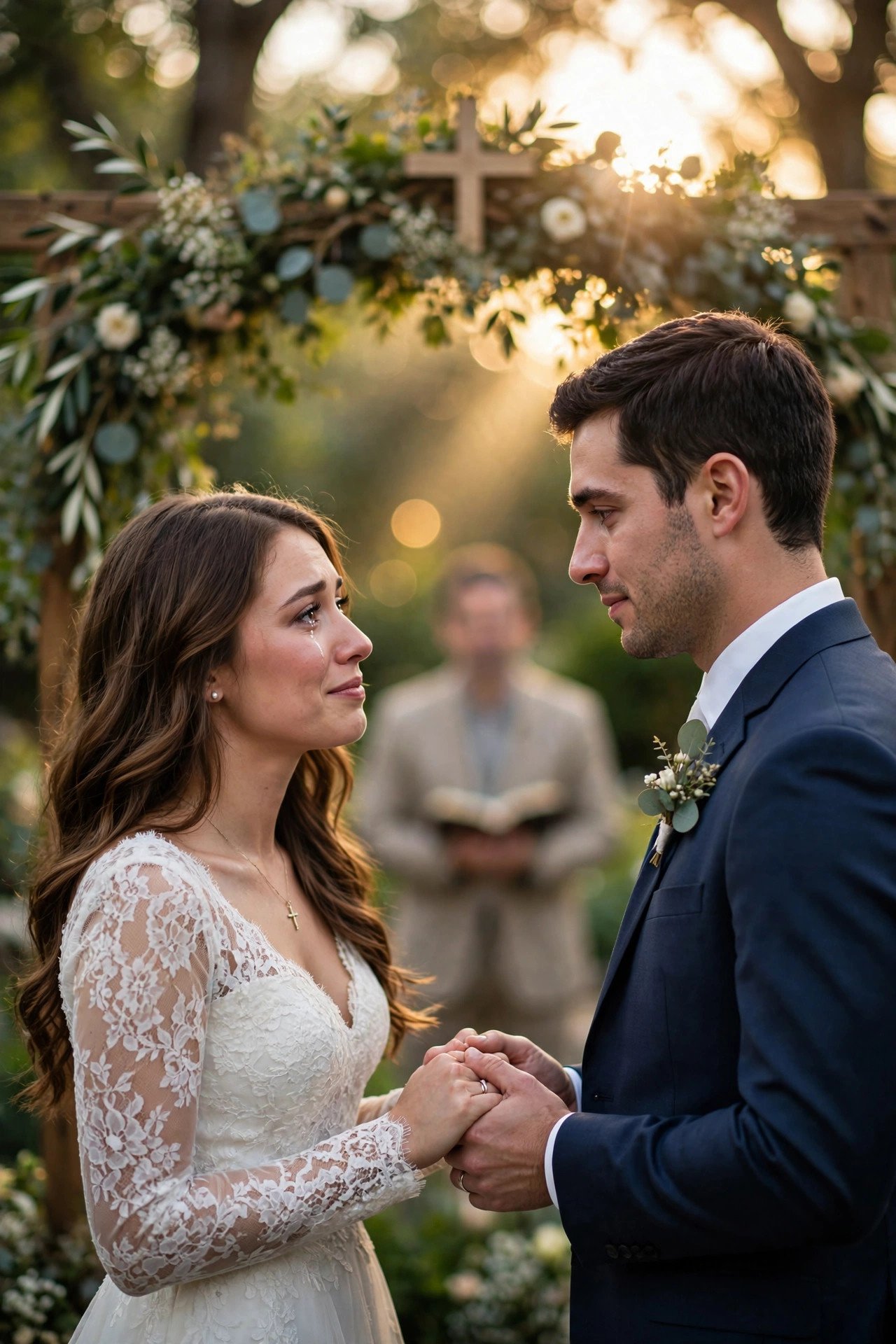
Name the belief behind the promise — faith, family, adventure — in one honest line, not a sermon.
The vows couples treasure most usually contain one line about what grounds them: a shared faith, a family value, a life philosophy. It doesn’t need to be long — “Before God and everyone we love” or “Because we both believe home is a person, not a place” — but it gives every other promise a foundation. If you and your partner share a faith tradition, one line honoring it will mean more to your families than any poetry.
Wish I’d said it: “I promise these things not just to you, but before the God we both trust to hold us to them.”
Read next: 101 Questions for Muslim Couples to Ask Before Marriage
Humor: One Laugh, Max
 📌 Save
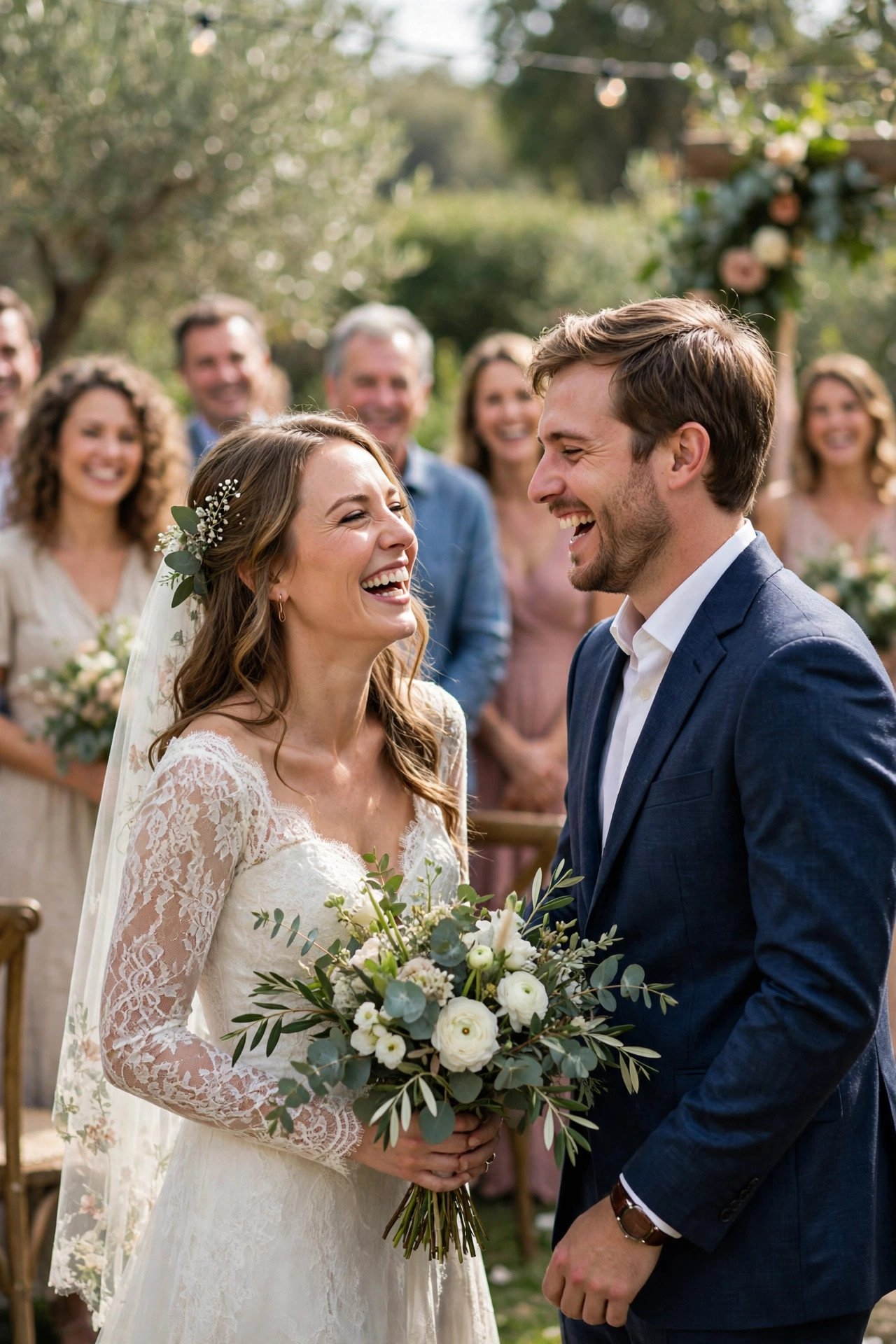
Allow yourself exactly one funny line — placed early, self-deprecating or warm, never at your partner’s expense.
Humor in vows works like salt: a pinch enhances, a handful ruins. The best vow humor is warm and slightly self-deprecating — it relaxes you, relaxes the guests, and makes the sincere lines land harder. Place it in the first third, then let the vows deepen. Never joke about exes, in-laws, or anything your partner is sensitive about; the altar is not a comedy club and the video lasts forever.
Wish I’d said it: “I promise to love you even when you steal the blankets — which, let’s be honest, is a bigger commitment than ‘for worse.'”
The Closing Line That Sticks
 📌 Save
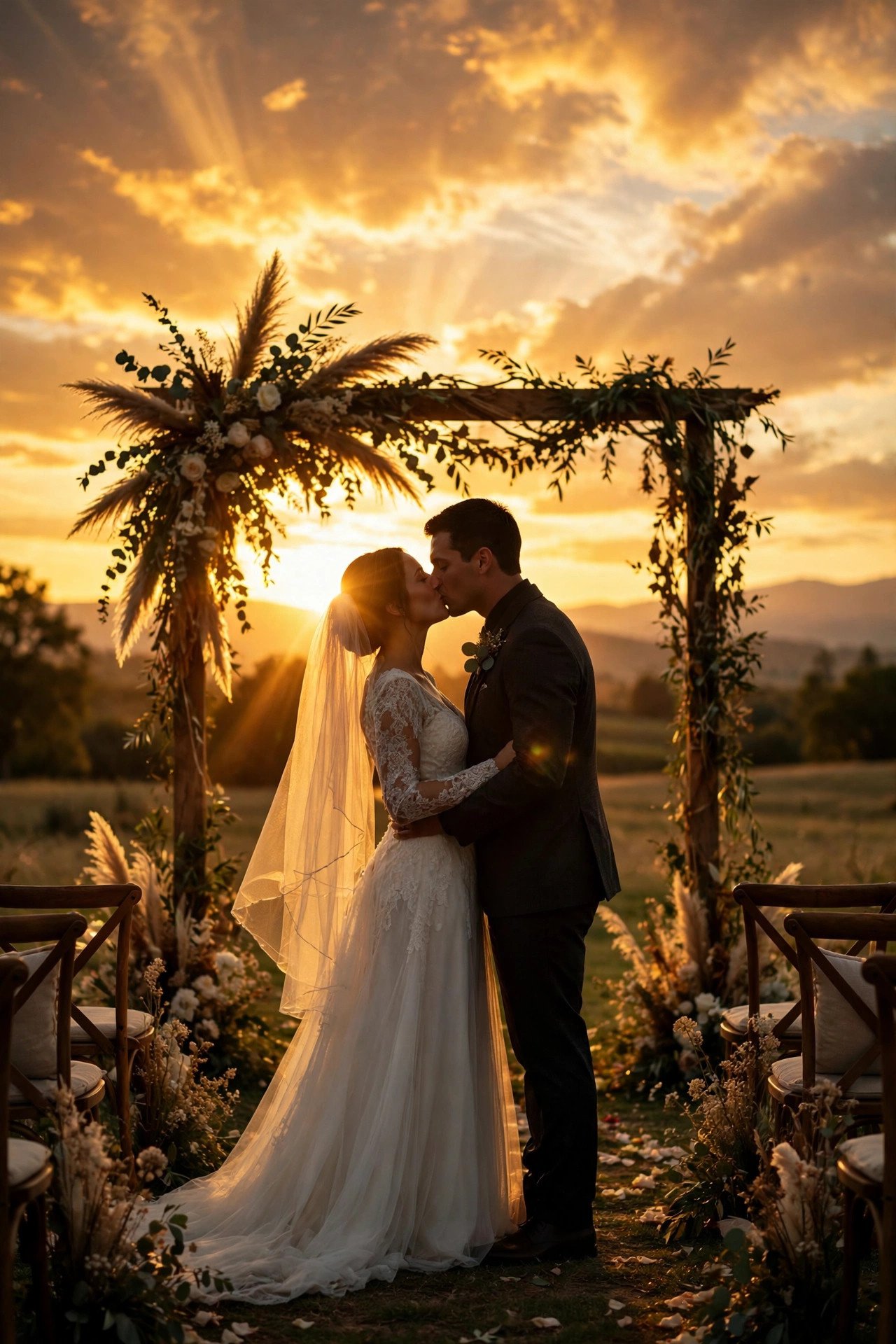
Write your last line first — it’s the one everyone remembers, so make it short, true and forward-looking.
Psychology backs this up: people remember endings most. Your closing line should be the shortest, truest sentence in your vows — a forward-looking promise, not a summary. “Today I marry my best friend” is fine; “I choose you — today, and every ordinary Tuesday after” is quotable. Write it first, then build toward it; everything before it is the runway.
Wish I’d said it: “You’re my favorite hello, my hardest goodbye, and — starting today — my always.”
The 5 Vow Mistakes to Skip
 📌 Save
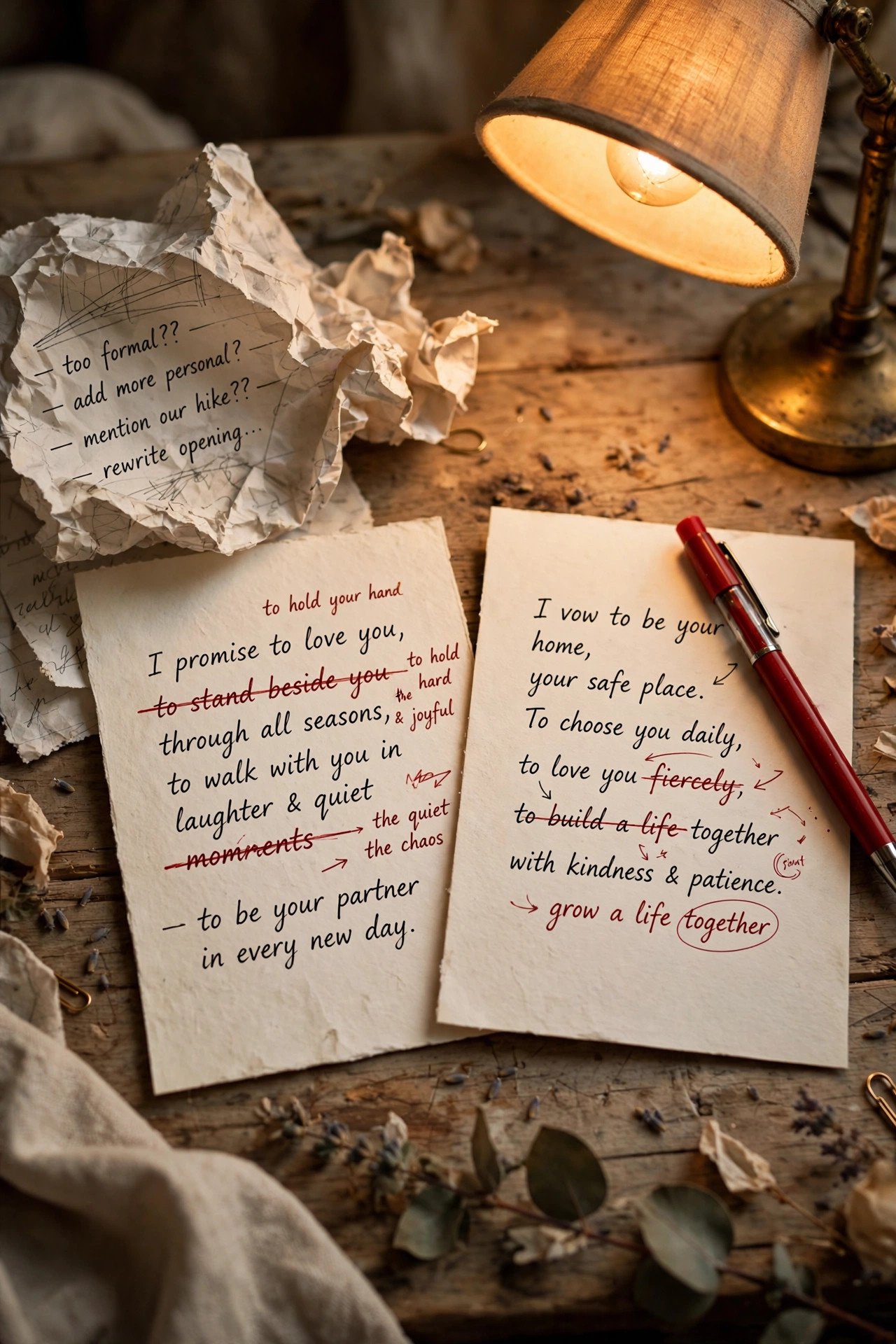
The five regrets, verbatim from married couples: too long, too vague, inside-joke heavy, mismatched with partner, and never practiced.
One: the ramble — five minutes that lost the room. Two: the greeting card — beautiful words that could belong to any couple. Three: the private joke set — hilarious to you two, baffling to eighty guests. Four: the mismatch — her sonnet, his shrug. Five: the cold read — stumbling over your own handwriting because you never read it aloud. Every one is preventable, and every lesson in this guide prevents one.
Wish I’d said it: “I almost wrote you a novel. Then I remembered: the best promises fit on one page.”
Read next: Don’t Make These Wedding Day Mistakes
Your Final Polish Checklist
 📌 Save
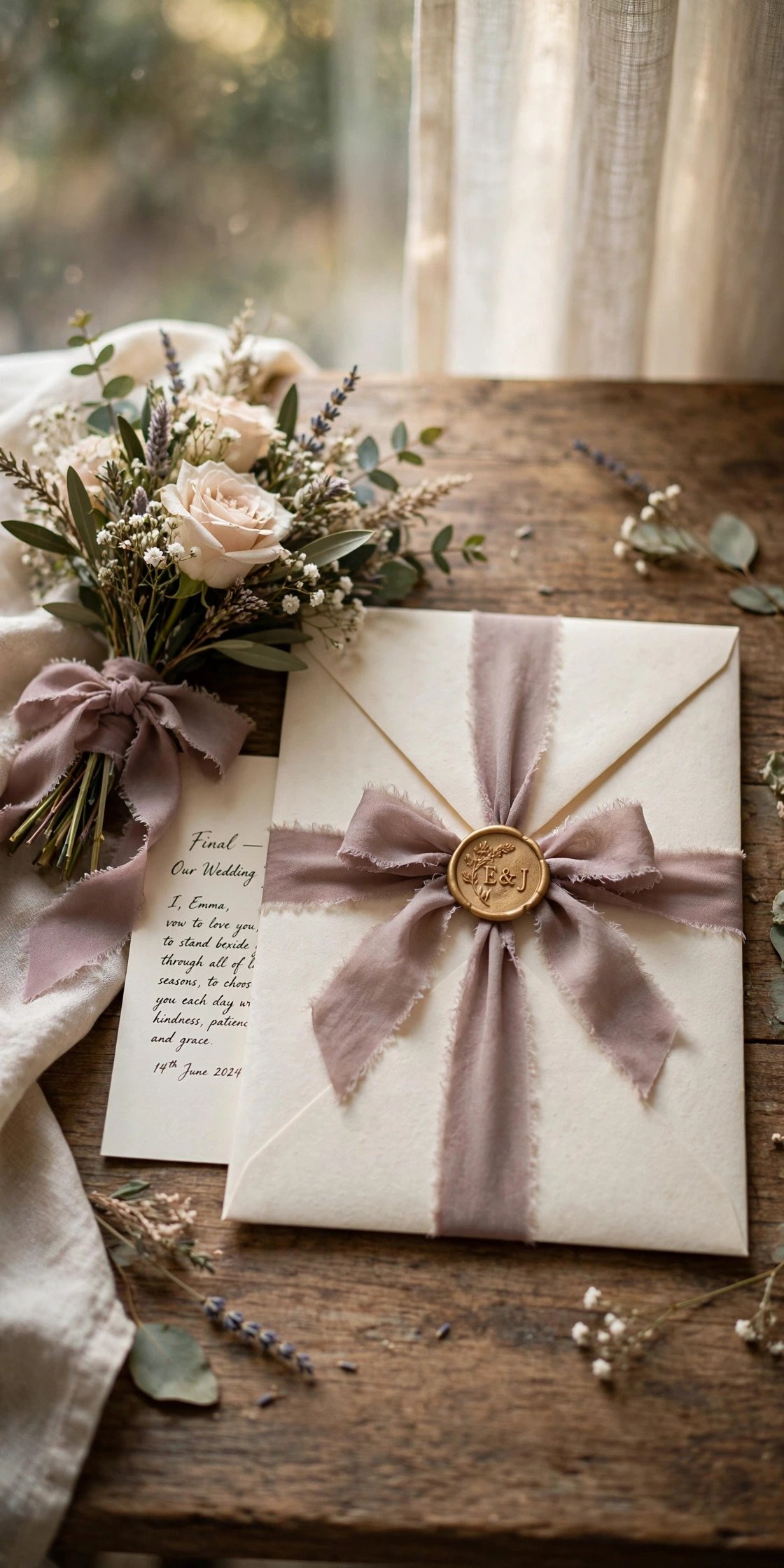
Run this checklist the night before: timing, tone-match, one value line, one laugh, specific details, strong close, printed card, officiant approved, practiced thrice, tissues ready.
The night before your wedding, sit with your vows and this list. Read them aloud one final time — slowly. Check the length against your partner’s (ask the officiant, not your partner). Confirm the printed card is in the getting-ready bag. Then put them away. You’ve done the work; trust it. Tomorrow, look at your person, breathe, and mean every word.
Wish I’d said it: “Everything I needed to say fit on this one card. The rest, I’ll spend a lifetime showing you.”
Read next: The 30 Days Before Your Wedding
Frequently Asked Questions
How long should wedding vows be?
Aim for 1–2 minutes when spoken — roughly 150–250 words. That’s long enough for a real promise and short enough to hold everyone’s attention. Time yourself reading aloud; written words always take longer to say than you think.
Should couples write vows together or separately?
Agree on the format together (length, tone, structure) and write the actual words separately. That way your vows match in style but stay a surprise in content. Share them with your officiant a week before for a final check.
Is it okay to cry while reading wedding vows?
Completely — guests love genuine emotion. The trick is preparation: read your vows aloud several times so you’re familiar, not surprised, by your own words. Keep tissues nearby and pause rather than rushing through tears.
Can I include humor in my wedding vows?
Yes, but ration it: one genuine laugh is perfect, a comedy routine is not. Humor works best as a warm aside inside sincere promises. Avoid inside jokes guests won’t understand and anything at your partner’s expense.
What if I’m not a good writer?
Vows reward honesty, not vocabulary. Start by answering simple prompts (when did you know, what do you admire, what do you promise), then arrange the answers into the 3-part structure. Specific, plain-spoken vows move people more than flowery ones.
✨ Key Takeaways
- Start with your “why” — one sentence about why this person, before any drafting.
- Use the 3-part structure: your story, what you love, what you promise.
- Keep vows to 1–2 spoken minutes (150–250 words) and read them aloud three times.
- Specific details beat poetry; one laugh max; end with a quotable closing line.
- Coordinate format with your partner, write separately, and get officiant approval.
Final Thoughts
The vows you wish you’d said are still yours to say — that’s the beautiful secret of this whole guide. Write them with structure, keep them specific and short, practice until they feel like breathing, and deliver that last line looking into their eyes. Years from now, you won’t remember the flowers. You’ll remember these words — because you wrote them well.


