
How to Plan a Wedding on a Small Budget
By zainzari • Published April 2026 • Updated October 11, 2026
 📌 Save
To plan a wedding on a small budget, follow the timeline, not just the tips: 12+ months out set your budget and guest list; 10–12 months book an off-peak venue; 8–9 months lock vendors and attire; 6–7 months finalize food and flowers; 4–5 months handle paper and details; 3 months do fittings and final counts; 6 weeks confirm everything in writing and sprint through DIY; 2 weeks out stop deciding and start resting; final 48 hours are for setup only; wedding day is for enjoying it. One phase at a time keeps spending — and stress — under control.
Most budget wedding advice tells you WHAT to cut. This guide tells you WHEN to decide — because on a small budget, timing is money. Book the venue late and you pay peak prices. Order the dress late and alterations go rush-rate. Decide everything in the final month and you’ll panic-buy your way over budget.
Think of this as your project plan: ten phases from a year out to the wedding morning, each with exactly what to book, what to save, and what NOT to think about yet. Follow the phases in order and the budget takes care of itself.
At a Glance: Phase, Book This & Save Here
| Phase | Book / Decide | Save By |
|---|---|---|
| 12+ months | Budget, guest list, priorities | Deciding before spending |
| 10–12 months | Venue, date | Off-peak timing |
| 8–9 months | Photographer, attire | Students & pre-owned |
| 6–7 months | Food, flowers | Restaurants & wholesale |
| 4–5 months | Invitations, music, cake | Digital & DIY |
| 3 months | Fittings, final counts | Avoiding rush fees |
| 6 weeks | Confirm all vendors | Catching errors early |
| 2 weeks | Nothing new | Not panic-buying |
| 48 hours | Setup only | Delegating, not doing |
| Wedding day | Enjoy it | Being present |
The order is the strategy: each phase’s decisions depend on the previous one. Never skip ahead.
12+ Months Out: The Foundation
 📌 Save
Decide three things now: your total budget, your guest list, and your two non-negotiables.
This phase costs nothing and saves everything. Set a real total budget — not a wish, a number — and split it across categories. Finalize the guest list before anything else, because every name multiplies costs. Then name your two non-negotiables: the two things you’ll remember in ten years (usually photos and food). Write them down. Every future decision gets measured against them.
Do NOT book anything yet, no matter how tempting the “limited offer” is. Decisions made before the foundation exists are how budgets die in month one.
Read next: How to Plan Your Dream Wedding Under $5,000
10–12 Months: Venue & Vision
 📌 Save
Book one venue for ceremony and reception, on a Friday, Sunday or off-season date.
The venue is your biggest single booking and the decision everything else hangs on — capacity, catering rules, decor needs, even your timeline. Tour with your guest count and budget in hand, and ask what’s included (tables, chairs, linens, sound) before comparing prices. Then attack the date: off-peak timing routinely cuts venue costs 20–40%, the largest single discount in budget wedding planning.
Lock your vision here too — not a Pinterest board of 500 pins, but three words describing the feeling (rustic-romantic, modern-minimal, garden-party). Every future purchase gets filtered through those three words.
8–9 Months: Vendors & Attire
 📌 Save
Book your photographer and buy attire now — both categories punish procrastinators with higher prices.
Good budget photographers (students, talented part-timers) book up 6–9 months out — the affordable ones disappear first. Contact photography programs and book your favorite now. For attire, start shopping immediately: pre-owned gowns, sample sales and off-the-rack suits all need 3–4 months for alterations, and rush alterations can double the tailoring bill. This is also the moment to book any other must-have vendor (officiant, day-of coordinator).
Budget $100–$150 for alterations separately, and never skip the contract — even student photographers should sign a simple agreement covering hours, deliverables and backup plans.
Read next: 10 Ways to Get Freebies for Your Wedding
6–7 Months: Food & Flowers
 📌 Save
Lock your food format and flower strategy — both are cheaper when decided early, not urgently.
Food: choose your format (buffet, stations, restaurant drop-off), get three itemized quotes, and book. Six months out, restaurants and caterers still have your date — at three months, you’re choosing from leftovers. Flowers: decide DIY versus florist now. DIY needs wholesale ordering timelines and a practice arrangement; a florist needs a deposit and a clear brief (in-season, greenery-heavy, three hero pieces).
This is also when you finalize the cake: small display cake plus sheet cake, ordered now, is always cheaper than a last-minute full custom order.
Read next: How to Do Wedding Food on a Budget: A Complete Guide
4–5 Months: Paper & Details
 📌 Save
Send invitations, lock music and cake, and finalize your decor plan — all the medium decisions, one calm phase.
Invitations go out now (6–8 weeks is the minimum; earlier is kinder for traveling guests). Go digital or DIY to keep this under $100. Lock music — build the playlists, rent the speaker, book student ceremony musicians. Finalize the decor plan with exact quantities per table, and start buying non-perishable supplies (candles, vases, fabric) during sales. Order the cake and confirm the design in writing.
Resist upgrading anything this phase. The “while we’re at it” purchases of months 4–5 are the classic budget killer — your phase-1 priorities are the only filter you need.
Read next: 20 Wedding Craft Ideas for Low Budgets
3 Months: Fittings & Final Counts
 📌 Save
First fitting now, RSVP deadline now, final headcount to every vendor now.
Three months out is about converting estimates into exact numbers. Book the first dress fitting (alterations need two rounds minimum). Set the RSVP deadline for 4 weeks before the wedding — late RSVPs cascade into every vendor count. Send final headcounts to the caterer, baker and rental company; most allow small adjustments later, but the base number locks now. This is also when you buy wedding insurance if you want it — it’s cheap and covers the nightmares.
Review the budget spreadsheet line by line this month. With three months left, there’s still time to rebalance — at three weeks, there isn’t.
Read next: The 30 Days Before Your Wedding
6 Weeks: Confirmations & DIY Sprint
 📌 Save
Email every vendor for written confirmation, then run your DIY sprint with helpers and a deadline.
Six weeks out, send every vendor the same email: “Confirming [date], [time], [deliverables], [balance due].” Written confirmations catch the misunderstandings while there’s time to fix them. Then: the DIY sprint. Gather your supplies, recruit your crew, and batch-produce everything — centerpieces, signage, favors — in one or two dedicated weekends. Everything must be DONE (not started) by the two-week mark.
Make a “wedding box” for every location — ceremony box, reception box, getting-ready box — and pack finished items into them as you go. Labeled boxes prevent the 6am wedding-day treasure hunt.
2 Weeks: The Calm-Before Fortnight
 📌 Save
The rule for the final two weeks: no new ideas, no upgrades, no “improvements.” Only execution.
Every budget blowout story includes the phrase “two weeks before the wedding, we decided to…” — upgrade the flowers, add the photo booth, change the menu. Don’t. Your plan is good; trust the year of work behind it. Use these two weeks for: final fitting, packing the wedding boxes, confirming vendor arrival times, preparing tips in labeled envelopes, and resting. If a new idea appears, write it down for someone else’s wedding.
This is also when you protect your health: sleep, hydrate, don’t try new skincare. A calm, rested couple photographs better than any upgrade.
Read next: Don’t Make These Wedding Day Mistakes
Final 48 Hours: Setup & Rest
 📌 Save
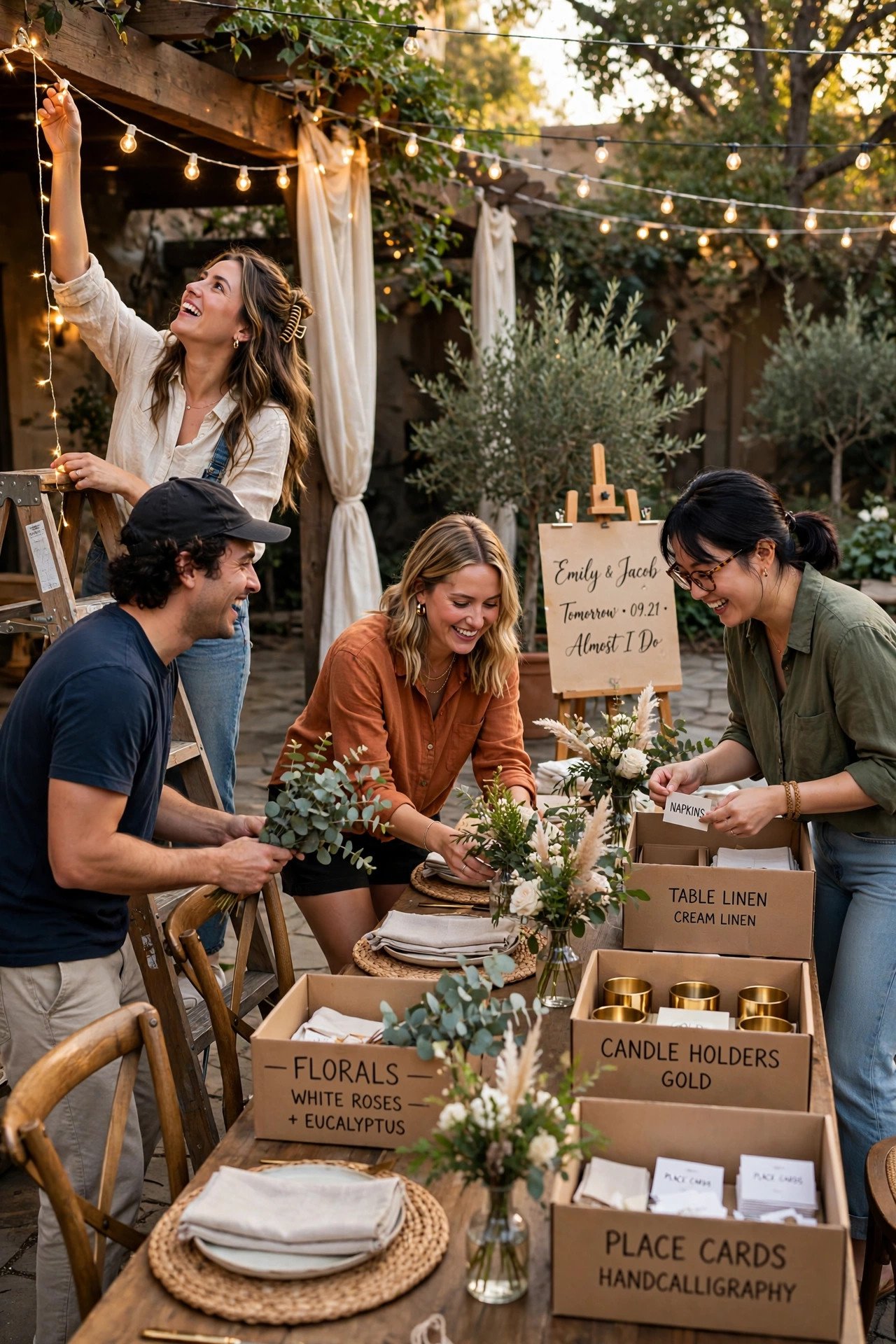
Day before: others set up from your labeled boxes and photos. You: rehearse, eat, sleep.
The final 48 hours have exactly two jobs: setup and rest — and you’re only doing one of them. Hand your setup crew the labeled boxes, the setup photos and one contact person (not you). Rehearse the ceremony, eat a real dinner, and get to bed early. Wedding morning: get ready slowly, eat breakfast, and let the quarterback (your mom, your coordinator, your best friend with a clipboard) run the timeline.
Keep the $250 buffer envelope accessible — not for upgrades, but for the forgotten, the broken and the “we need ice” moments. That’s what it’s for.
Read next: 10 Items to Bring to Your Bridal Getting-Ready Room
Wedding Day: Enjoy Every Minute
 📌 Save
Your only job today: be present. Eat the food, dance badly, talk to everyone, feel everything.
Something small will go wrong — a wilted boutonniere, a late vendor, a seating mix-up. Here’s the secret: if you don’t react, nobody notices. The day is 95% perfect by design; your calm covers the other 5%. Eat when food is served (seriously — couples forget), take the five quiet minutes with your person, and dance even if you’re terrible at it. These are the memories, not the centerpieces.
And when it’s over, you’ll have something most couples don’t: a marriage that starts at zero debt. That’s the real luxury of a small-budget wedding — it ends, and the good part begins.
Read next: 12 Wedding Vows I Wish I Would Have Said
Frequently Asked Questions
How far in advance should I plan a small-budget wedding?
12 months is ideal — it gives you time to catch off-peak dates, compare quotes and DIY without rushing. But small-budget weddings can absolutely be planned in 6 months or less, since simpler formats (backyard venues, restaurant catering, digital invitations) need far less lead time than traditional ones.
What should I book first on a small budget?
Set your budget first, then finalize the guest list, then book the venue — in that order. The venue is the foundation everything else depends on (date, capacity, catering rules). After that: food, attire, photographer, then decor and details.
How do I avoid overspending while planning?
Track every dollar in one shared spreadsheet from day one, keep a 5% buffer untouched, and apply the 48-hour rule to any unplanned purchase over $100. Most overspending comes from small unlogged buys and emotional upgrades, not from the big vendor decisions.
Can I plan a budget wedding in 6 months?
Yes — start at phase 4 of this roadmap and compress. Choose venues and vendors with availability (off-peak dates help enormously), buy attire off-the-rack or pre-owned, go digital for invitations, and keep the design simple. Short timelines actually prevent budget creep because there’s less time to second-guess.
What do most couples forget when planning on a budget?
The hidden costs: service charges, tips, delivery fees, alterations, marriage license, and vendor meals. Budget 10–15% beyond quoted prices for these. Also forgotten: a day-of coordinator (even a friend with a clipboard), a rain plan, and an emergency kit.
✨ Key Takeaways
- Follow the phases in order — each decision depends on the previous one.
- Book venue, photographer and attire early; all three punish procrastination.
- Decide food and flower formats at 6–7 months, not urgently at 6–7 weeks.
- The final two weeks are for execution only — no new decisions, no upgrades.
- On the wedding day, your only job is to be present. The plan handles the rest.
Final Thoughts
A small budget doesn’t limit your wedding — rushing does. Give yourself the full timeline, make one phase of decisions at a time, and trust the plan when the final weeks get loud. Do that, and you’ll walk down the aisle calm, prepared, and debt-free. That’s not just a budget wedding. That’s a well-planned one.





2 Comments