Catholic Wedding Ceremony (2027)
By zainzari • Published October 23, 2026 • Updated October 23, 2026
 📌 Save
A Catholic wedding is the Sacrament of Matrimony, celebrated either within a Nuptial Mass or as a ceremony with the Liturgy of the Word. Its heart is the couple’s exchange of consent — in Catholic teaching the couple themselves confer the sacrament on each other, with the priest or deacon receiving their vows on behalf of the Church. Couples prepare through Pre-Cana, choose readings from approved options, and plan the liturgy with their parish. This guide walks through every part in order; requirements vary by parish and diocese, so your own parish is always the final authority.
A Catholic wedding ceremony is both more structured and more personal than many couples expect: the rite has a fixed, beautiful skeleton — processional, readings, consent, rings, blessing — and within it the couple makes real choices: readings, music, readers, intentions, and whether their wedding is celebrated within Mass. Guests of every background find the ceremony easy to follow and quietly moving when the couple provides a simple program.
These 25 parts of the Catholic wedding are explained in the order you will meet them, from booking the parish a year out to the recessional — including Pre-Cana, mixed-faith situations, Communion guidance for guests, and beloved cultural additions like the lasso, arras and flowers to Mary. Rules genuinely vary between parishes and dioceses: treat this guide as your orientation, and your parish meeting as your rulebook.
At a Glance: Parts of a Catholic Wedding, in Order
| # | Tradition | What It Is | When It Happens |
|---|---|---|---|
| 1 | Marriage as a Sacrament | one of the seven sacraments, conferred by the couple themselves | Foundations |
| 2 | The Nuptial Mass vs. a Ceremony with the Liturgy of the Word | two forms: wedding within Mass, or readings and rite without Communion service | Foundations |
| 3 | Pre-Cana — Marriage Preparation | required preparation: courses, conversations and a premarital inventory | Months before |
| 4 | Talking to Your Parish Early — Booking and Documents | church booking, baptismal certificates and freedom-to-marry paperwork | 6–12 months before |
| 5 | When One of You Isn’t Catholic | permissions, the ceremony form, and honest conversation | Planning |
| 6 | The Processional — Walking In Together | the couple may process together, or the bride is escorted | Ceremony opens |
| 7 | Readings Chosen by the Couple | Old Testament, psalm, New Testament and Gospel from approved options | Liturgy of the Word |
| 8 | The Responsorial Psalm and Sacred Music | the psalm is sung between readings; music follows parish guidelines | Liturgy of the Word |
| 9 | The Gospel and Homily | the priest or deacon proclaims the Gospel and preaches | Liturgy of the Word |
| 10 | The Exchange of Consent — The Vows | the heart of the sacrament: free consent in the Church’s words | The Rite of Marriage |
| 11 | Blessing and Exchange of Rings | the rings are blessed and placed as signs of love and fidelity | The Rite of Marriage |
| 12 | The Unity Candle — An Optional Addition | a beloved custom in some places, not part of the official rite | After the rings |
| 13 | The Prayer of the Faithful | intercessions for the couple, families, Church and world | After the rite |
| 14 | The Sign of Peace | the congregation exchanges Christ’s peace with handshakes and embraces | Within Mass |
| 15 | The Liturgy of the Eucharist and Communion — A Guest Guide | at a Nuptial Mass, Communion is offered to Catholic guests | Within Mass |
| 16 | The Nuptial Blessing | a solemn blessing prayed over the couple, hands extended | Within the rite / Mass |
| 17 | Flowers to Mary — A Bouquet at the Statue | the couple presents flowers at a Marian image and prays briefly | After Communion / close |
| 18 | The Lasso, Arras and Velación in Hispanic Catholic Weddings | beloved cultural rites woven into the Catholic ceremony | Within the rite |
| 19 | Sponsors and Witnesses | two official witnesses sign; sponsors (padrinos) serve honored roles | Ceremony |
| 20 | Signing the Register and the Marriage License | church and civil paperwork are completed around the ceremony | After the ceremony |
| 21 | Church Etiquette and Photography | parish rules govern photos, dress expectations and movement | Ceremony |
| 22 | The Recessional — Walking Out Married | the couple exits to joyful music as the congregation applauds | Ceremony close |
| 23 | Timing — How Long Everything Takes | Mass about an hour; ceremony form about 30–45 minutes | Planning |
| 24 | The Rehearsal — Short, Practical, the Night Before | the wedding party walks through the ceremony with the coordinator | Day before |
| 25 | A Ceremony Guests of Every Faith Can Follow | a simple order-of-service program makes everyone comfortable | For your guests |
Planning note: book the church and meet your priest or deacon first — typically six to twelve months ahead. Almost every other decision hangs on that conversation.
Marriage as a Sacrament
 📌 Save
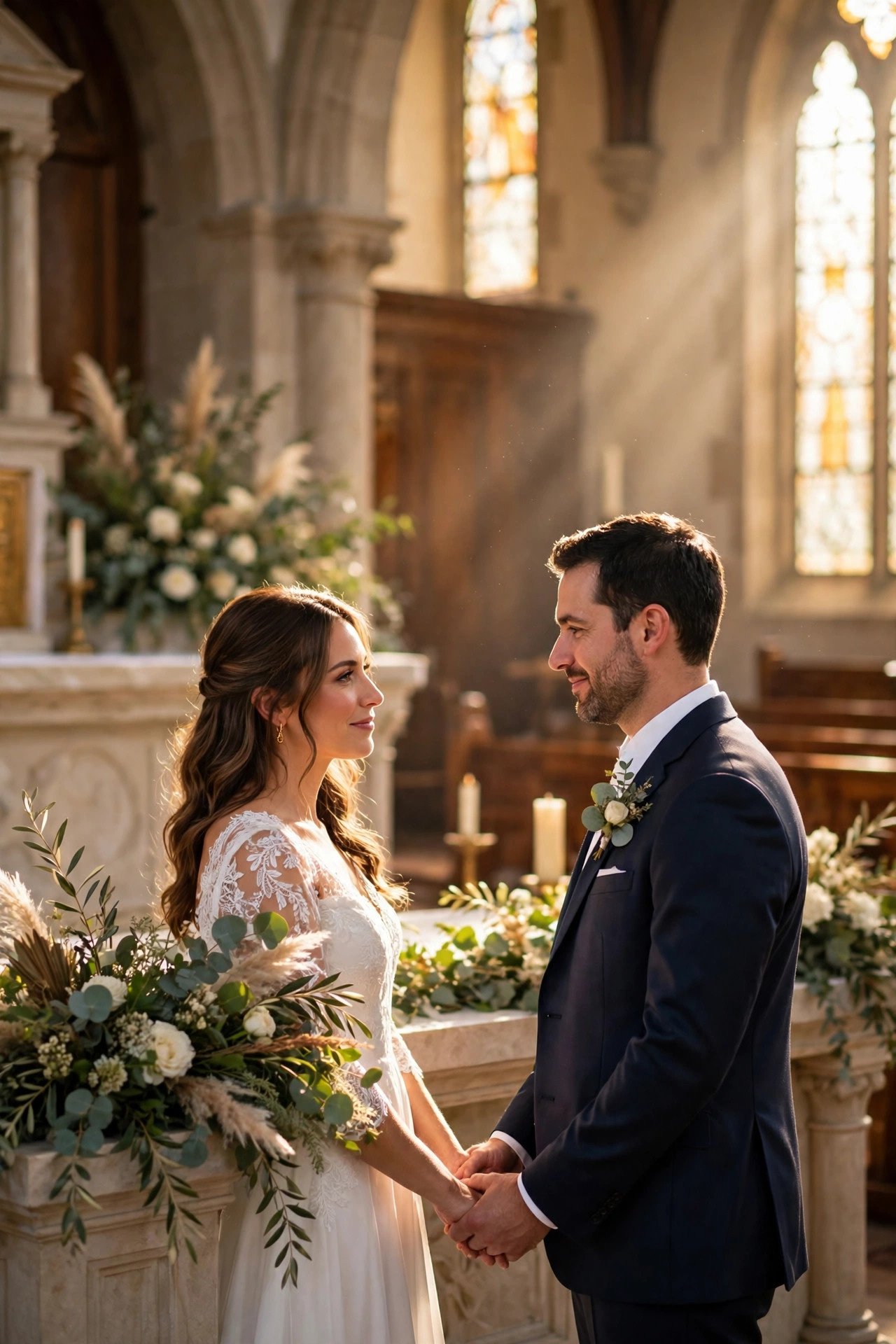
In Catholic teaching, marriage between baptized Christians is a sacrament — one of the seven — and, beautifully, the couple are its ministers: they confer the sacrament on each other through their free exchange of consent, while the priest or deacon receives the vows, blesses the union and witnesses for the Church. That theology shapes everything practical: the vows are the ceremony’s summit, the rings its sign, and the celebration is a liturgy of the Church, planned with the parish rather than a performance staged in one.
The Nuptial Mass vs. a Ceremony with the Liturgy of the Word
 📌 Save
Catholic weddings take two forms. In the Nuptial Mass, the marriage rite is woven into a full Mass with the Liturgy of the Eucharist, and the couple (and Catholic guests) receive Communion. In the ceremony form — the Rite of Marriage outside Mass — the Liturgy of the Word, consent, rings and blessing proceed without the Eucharistic liturgy. Two Catholics usually celebrate within Mass; when one partner is not Catholic, the ceremony form is often recommended so the whole congregation can participate fully in every part. Your priest advises based on your situation, not a formula.
Pre-Cana — Marriage Preparation
 📌 Save
Every Catholic wedding begins months earlier with Pre-Cana: the Church’s marriage preparation, named for the wedding at Cana. Its exact form varies by diocese — a parish course, a weekend retreat, sessions with a sponsor couple, meetings with your priest, and usually a premarital inventory (such as FOCCUS or Prepare/Enrich) that maps your strengths and growth areas as a couple. Far from a test to pass, most couples call it the most useful wedding expense they never itemized: guided conversations about money, family, faith and conflict, finished before the seating chart ever starts.
Talking to Your Parish Early — Booking and Documents
 📌 Save
Start at the parish — usually where the bride or groom is registered, or where the wedding will be held — six to twelve months out. The parish will confirm the date and celebrant, open your marriage file, and list the documents: typically a recent baptismal certificate for each Catholic partner (issued within six months, with notations), confirmation records, and affidavits or declarations of freedom to marry. If either of you has a prior marriage, tell the priest at the very first meeting — annulment questions take time, and priests would always rather hear early than late.
When One of You Isn’t Catholic
 📌 Save
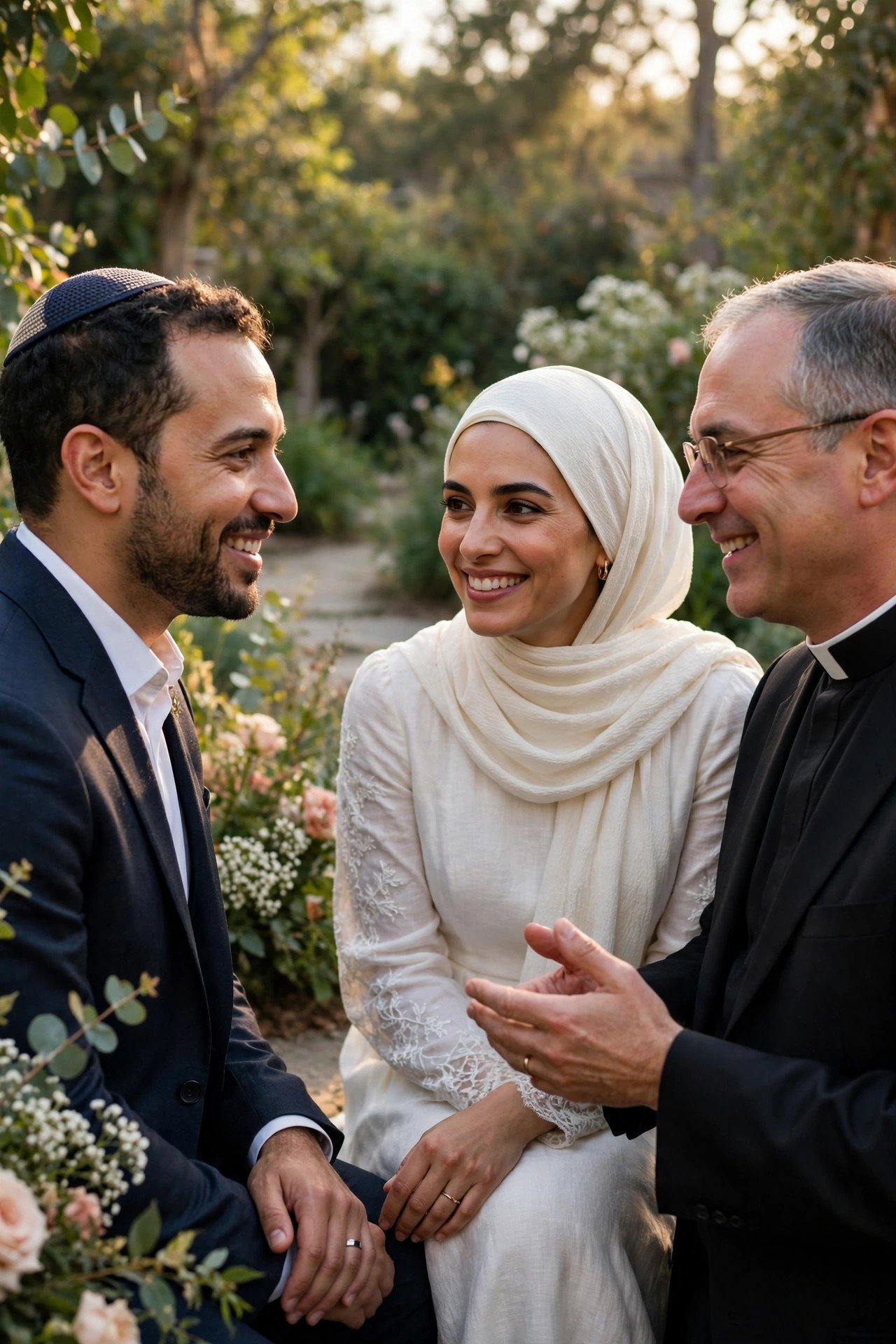
Catholic–non-Catholic weddings are everyday parish life, handled with clear, kind rules: the Catholic partner declares readiness to continue practicing the faith and promises to do all in their power to raise future children Catholic; the other partner is informed of that promise; and the diocese grants a permission (for a baptized Christian) or dispensation (for an unbaptized partner). The wedding usually uses the ceremony form outside Mass, held in church with the priest presiding. Only one piece of advice matters here: have the conversation with your priest early and honestly — surprises, not differences, are what strain the process.
The Processional — Walking In Together
 📌 Save
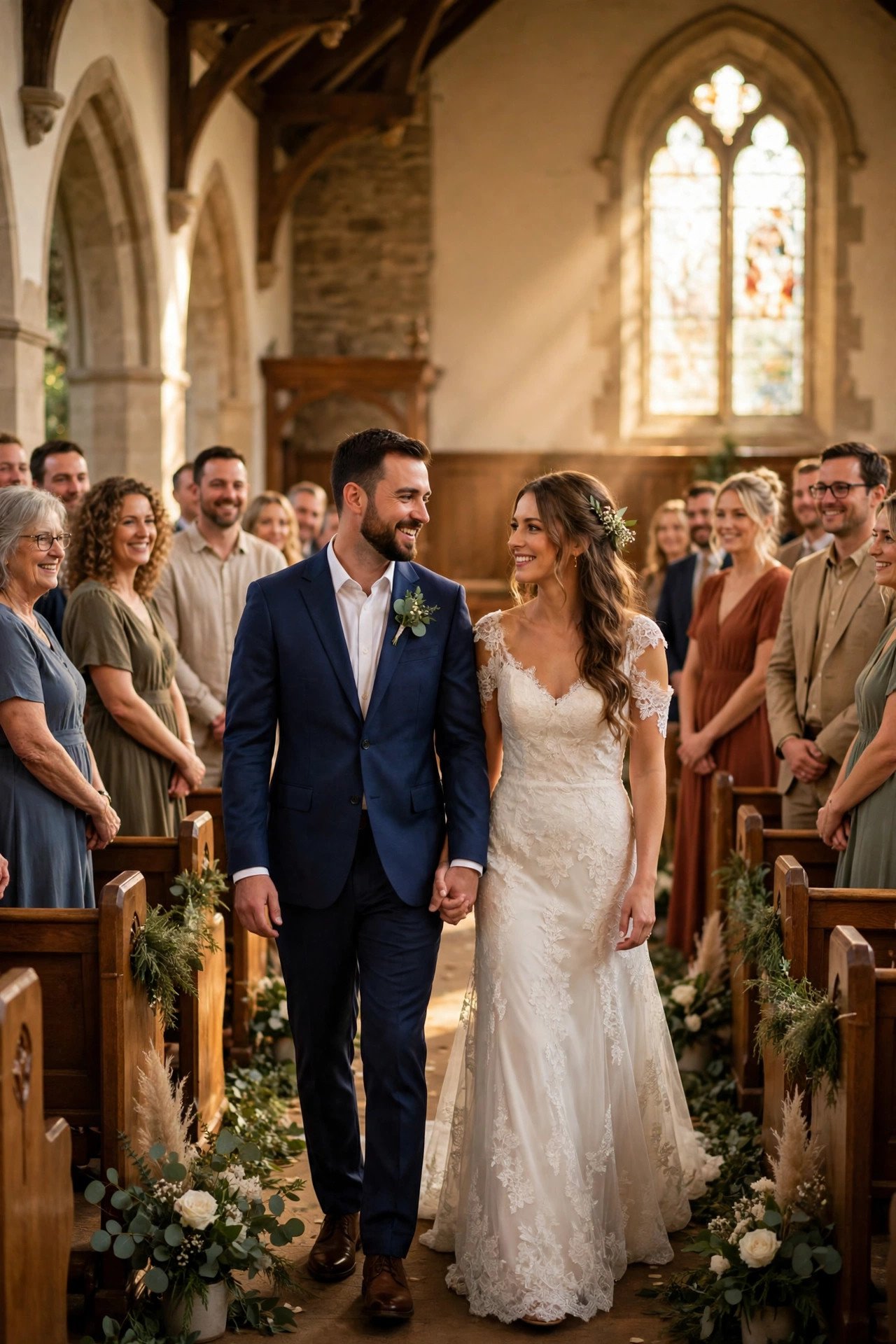
The Catholic rite imagines the couple arriving at marriage together, and in many countries the bride and groom process in side by side, sometimes behind the priest and ministers. North American custom more often has the bride escorted by her father or both parents — fully permitted and beloved. Some couples split the symbolism: the bride is escorted to the front, the couple then comes forward together to the altar. There is no ‘giving away’ language in the rite itself — the Church’s theology is of two free adults arriving at consent — so choose the entrance that tells your family’s story truthfully.
Readings Chosen by the Couple
 📌 Save
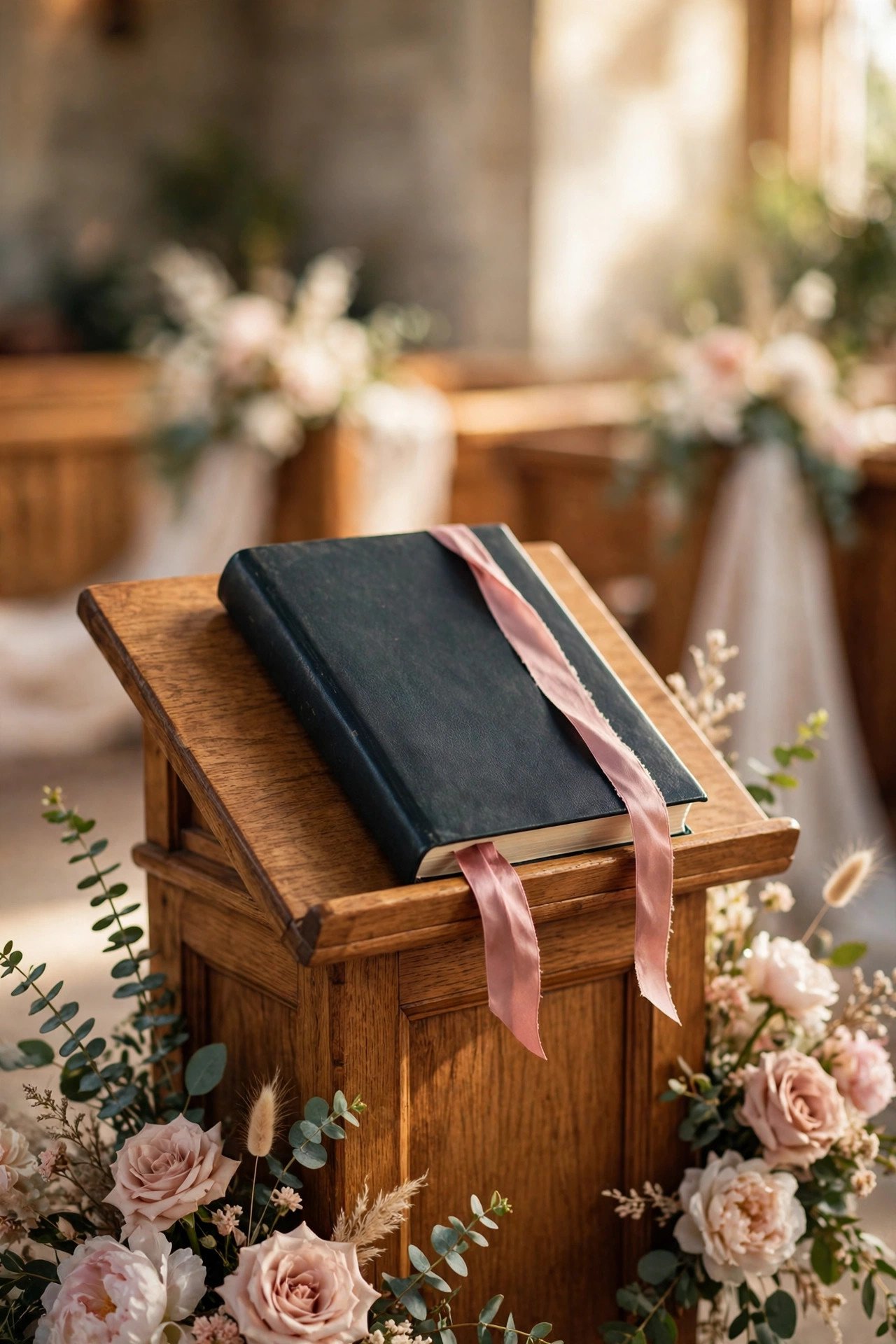
The couple chooses the ceremony’s readings from the Church’s approved wedding selections (gathered in the ‘Together for Life’ booklet most parishes provide): typically one Old Testament reading, a responsorial psalm, one New Testament reading, and a Gospel proclaimed by the priest or deacon. Classics recur for good reason — Genesis on companionship, Tobit on prayerful marriage, 1 Corinthians 13 on love, the wedding at Cana in John’s Gospel. Choose readers who read aloud well and brief them: these texts are proclaimed, not performed, and a practiced, unhurried reader is a gift to the whole church.
The Responsorial Psalm and Sacred Music
 📌 Save
Between the readings, the responsorial psalm is meant to be sung, led by a cantor, with the congregation answering the refrain — a small, lovely participation that even non-Catholic guests can join from the program. Wedding music in a Catholic church is sacred music: hymns and liturgical pieces chosen with the parish music director, who will know what suits the building and the rite. Secular love songs generally belong to the reception; where a beloved non-liturgical piece matters deeply, couples ask the music director early — some pieces find a place before the ceremony as prelude music, and honesty about the rules prevents rehearsal-week heartbreak.
The Gospel and Homily
 📌 Save
The Liturgy of the Word peaks with the Gospel — the congregation stands, an acclamation is sung, and the priest or deacon proclaims the passage the couple chose. Then comes the homily: the celebrant’s preaching, usually woven from the readings and the couple’s own story — how they met, what their love shows about God’s. A good wedding homily is remembered for decades, and celebrants write better ones when couples share, in their preparation meetings, the honest story they hope is honored.
The Exchange of Consent — The Vows
 📌 Save
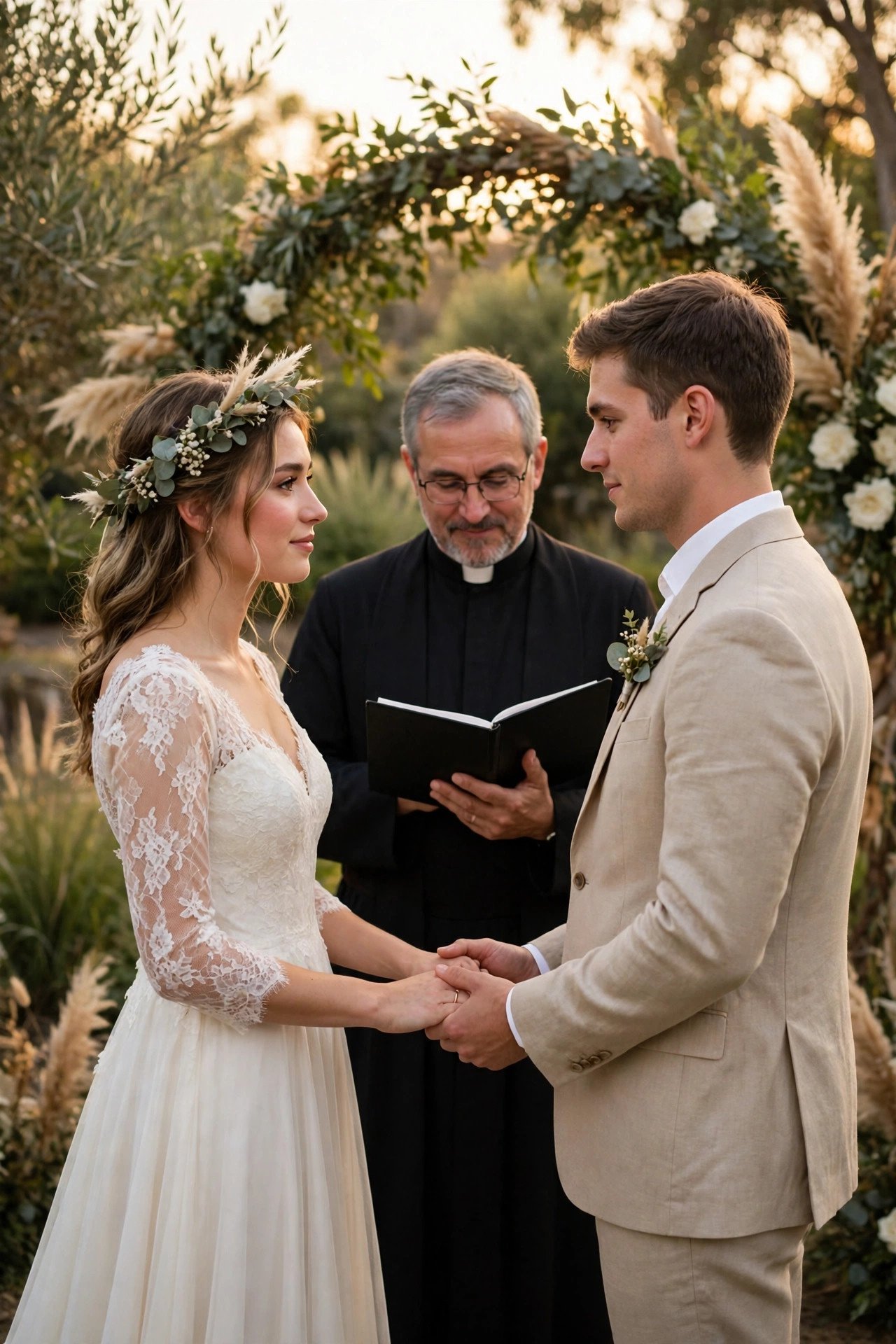
Everything narrows to this: the couple face each other, join hands, and exchange consent using one of the Church’s approved formulas — ‘I, [name], take you, [name], to be my wife/husband. I promise to be true to you in good times and in bad, in sickness and in health. I will love you and honor you all the days of my life.’ The priest first questions them about freedom, fidelity and openness to children, and then receives their consent. Personal vows are not substituted — the Church’s words carry the weight of a public, sacramental promise, identical in substance for every couple, which is precisely their power. Couples who want personal words read them at the reception, where they shine.
Blessing and Exchange of Rings
 📌 Save
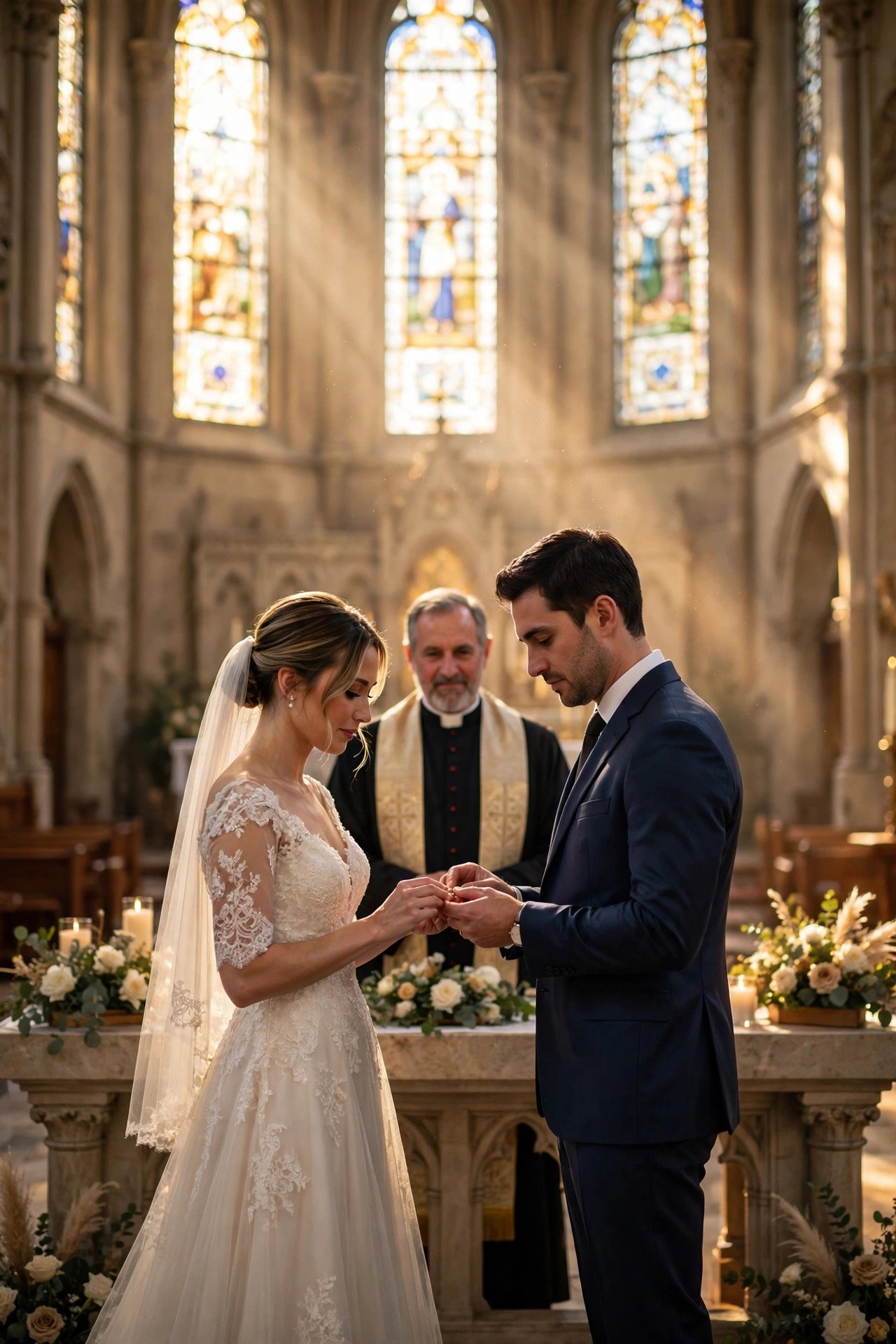
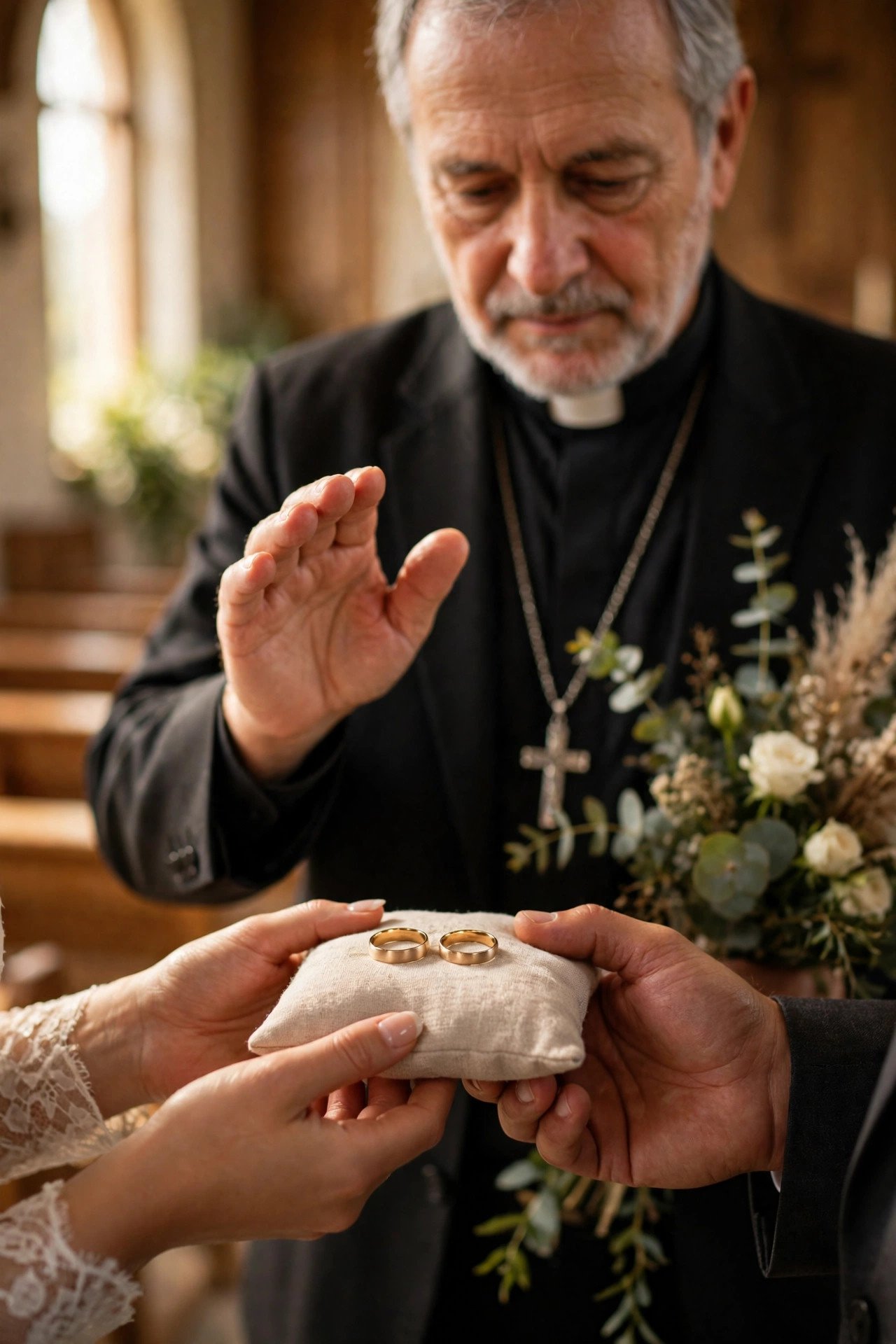
After consent, the priest blesses the rings — praying that those who wear them keep faith with each other — and the couple exchange them, each placing the ring on the other’s finger with the words ‘[Name], receive this ring as a sign of my love and fidelity. In the name of the Father, and of the Son, and of the Holy Spirit.’ The best man and maid of honor traditionally hold the rings until this moment. It is brief and jewel-like: the sacrament’s visible token, given twice, received twice, photographed a thousand times.
The Unity Candle — An Optional Addition
 📌 Save
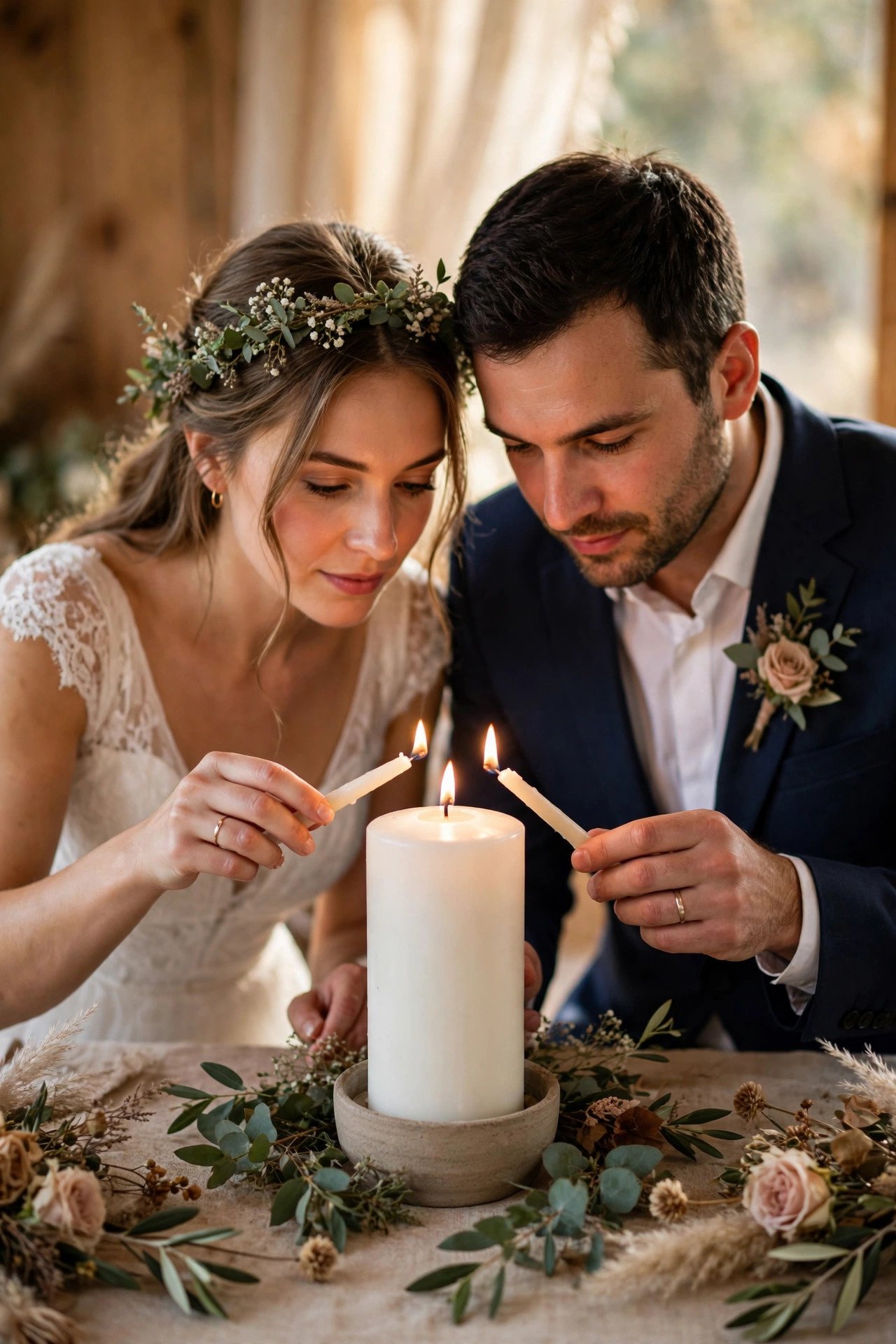
Many couples — especially in the USA — love the unity candle: two tapers (often lit by the mothers) flank a large candle, which the couple lights together after the rings, symbolizing two lives becoming one while their own flames remain. It is important to know it is a cultural custom, not part of the Church’s official rite, and parishes differ: some welcome it within the ceremony, some place it before Mass or at the rehearsal dinner, some decline it. Ask your parish early and accept their custom gracefully — if the candle cannot be in the church, lighting it at the reception’s head table keeps the symbol fully alive.
The Prayer of the Faithful
 📌 Save
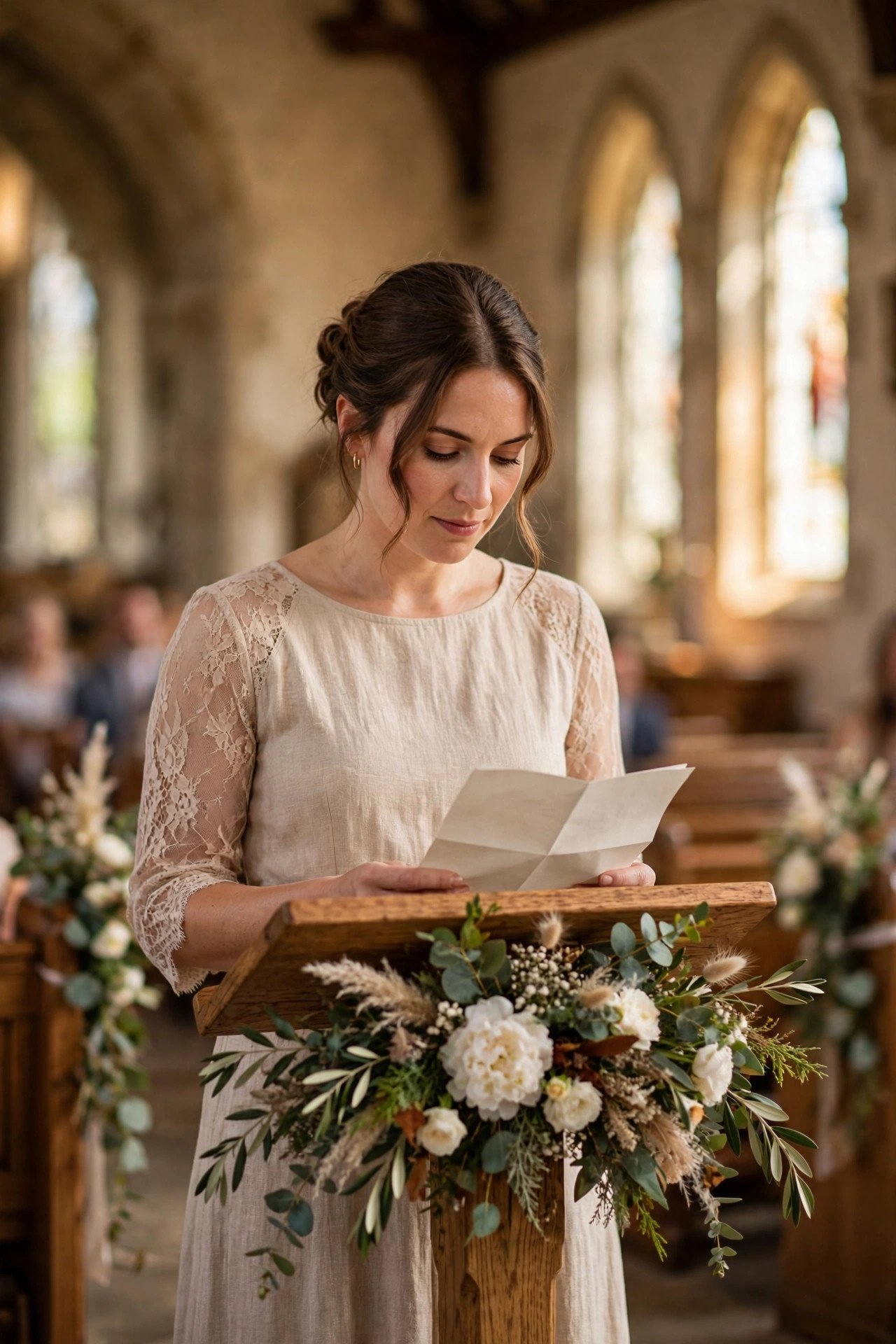
The congregation then prays the Prayer of the Faithful — a series of intentions, usually prepared with the couple: for the Church, for this couple and all married couples, for the families gathered, for those who could not attend, for the couple’s departed loved ones (named here with tenderness), and for the world’s needs. A family member or friend reads the intentions; the assembly answers ‘Lord, hear our prayer.’ This is where grandparents who have died are named aloud inside the joy — plan a tissue, and let that be fine.
The Sign of Peace
 📌 Save
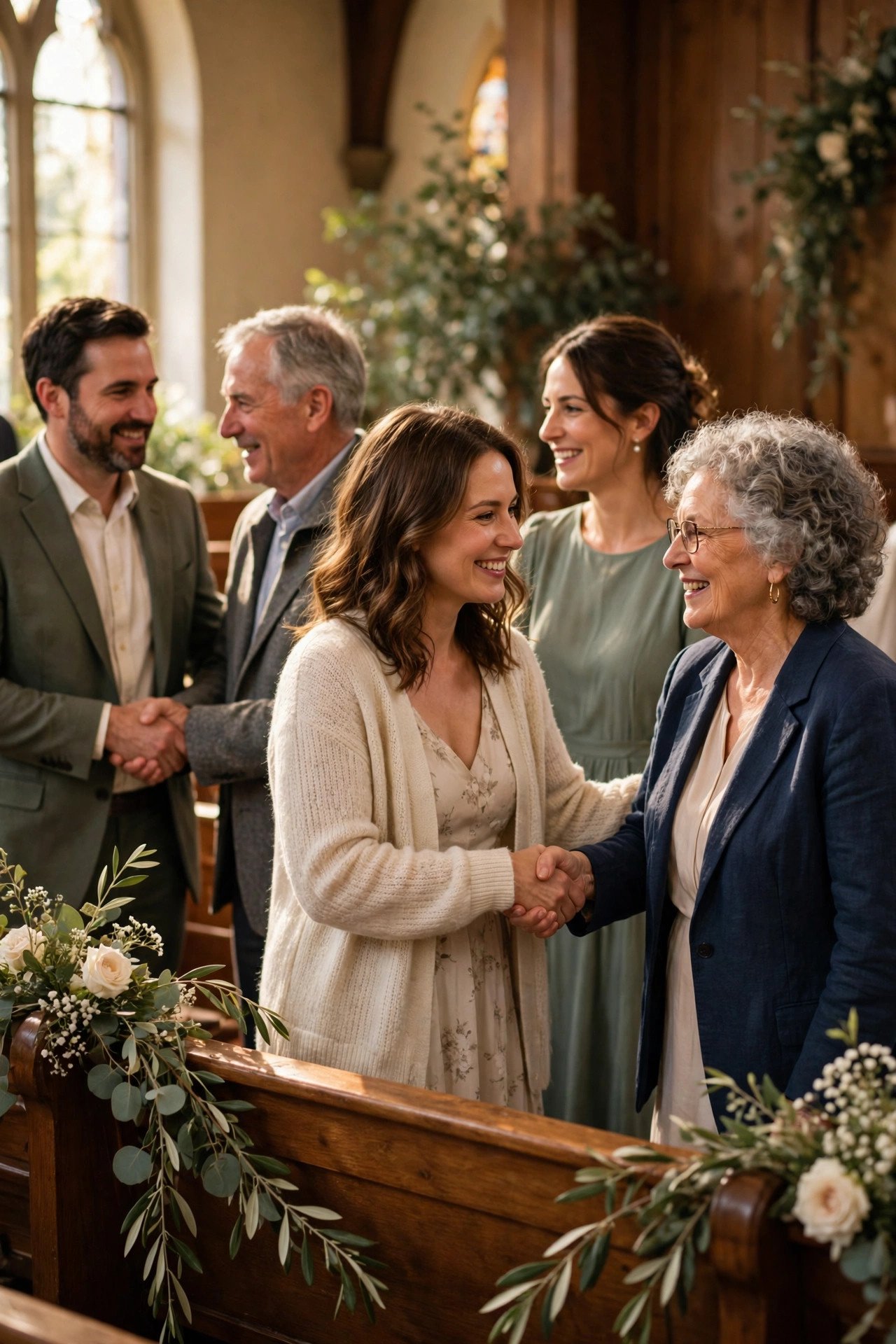
In a Nuptial Mass, after the Our Father and the nuptial blessing’s prayers comes the sign of peace: the priest invites the assembly to offer one another a sign of Christ’s peace, and the church fills with handshakes, hugs and smiles — the couple often sharing peace first with each other, then their parents and the front rows. It is the ceremony’s warmest minute, the moment formality melts. Guests of other faiths join exactly as they wish; a handshake and ‘peace be with you’ is the whole technique.
The Liturgy of the Eucharist and Communion — A Guest Guide
 📌 Save
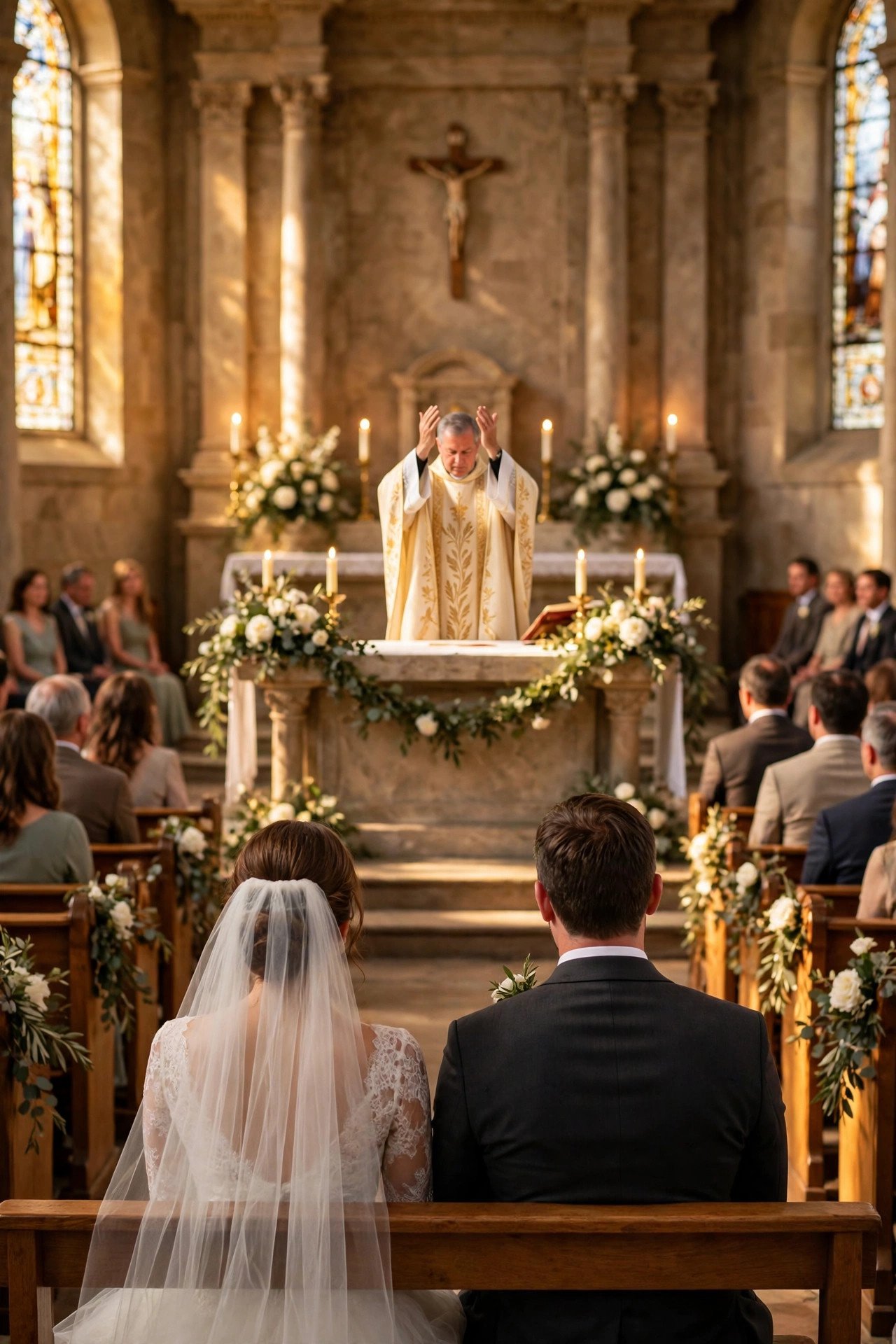
At a Nuptial Mass the Liturgy of the Eucharist follows: the gifts are brought up (often by family members), the Eucharistic Prayer is prayed, and Communion is distributed. Catholic practice is precise and welcoming at once: Catholics in good standing receive Communion; guests of other faiths, and Catholics not receiving, are invited to come forward with arms crossed over the chest for a blessing, or to remain seated in prayer — both are normal, unremarkable choices at every wedding Mass. The couple’s program should say so in one kind sentence, which experienced parish coordinators will happily help word.
The Nuptial Blessing
 📌 Save
At the rite’s solemn peak the priest prays the nuptial blessing over the couple — an ancient, expansive prayer (in a Mass it follows the Our Father; in a ceremony it crowns the rite) invoking God’s blessing on their love, fidelity, home and future children, while the assembly stands in reverent silence. In some traditions the couple kneels; in Hispanic celebrations a veil may be held over them (the velación) during it. The blessing is the Church’s formal benediction of what the couple’s consent created moments before — the room feels it land.
Flowers to Mary — A Bouquet at the Statue
 📌 Save
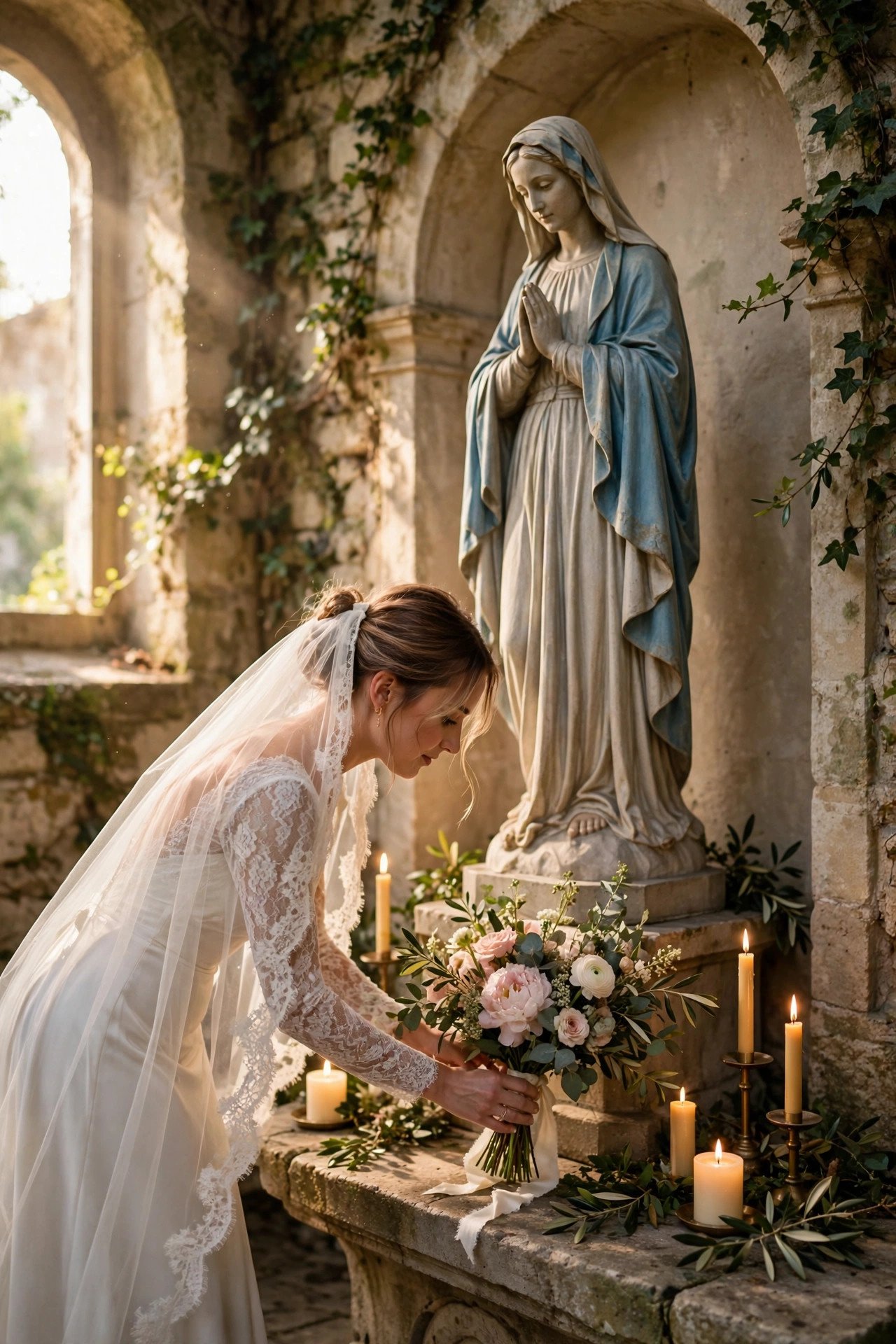
After Communion (in a Mass) or near the ceremony’s close, many couples walk together to a statue of the Virgin Mary, lay a small bouquet at her feet and kneel for a moment of private prayer — often while the Ave Maria is sung. The devotion asks Mary to watch over the marriage and gives the couple two minutes of stillness inside their own wedding. It is optional, arranged with the parish, and cherished fiercely by families who keep it; grandmothers in the front pew will be praying along with you, count on it.
The Lasso, Arras and Velación in Hispanic Catholic Weddings
 📌 Save
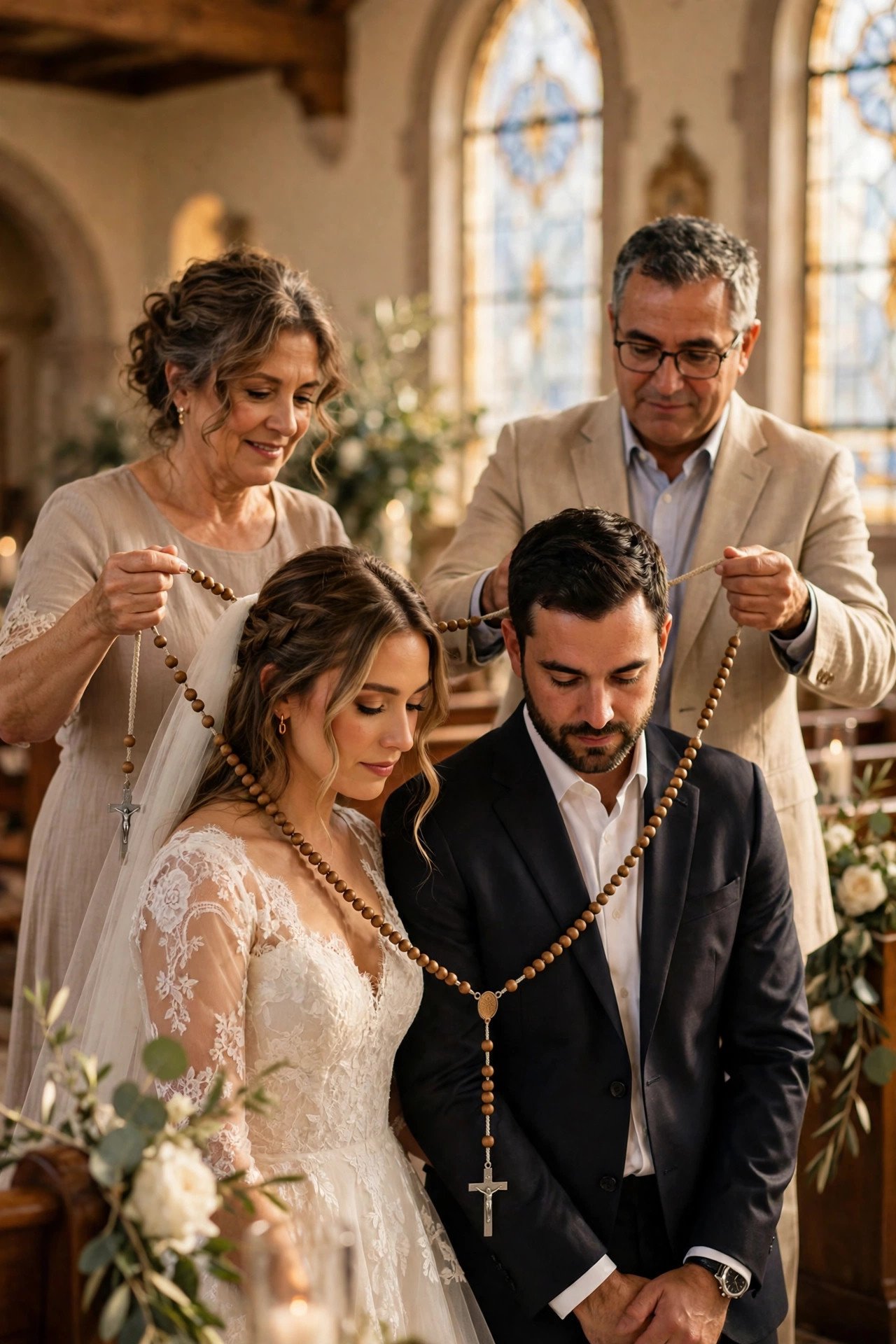
In Mexican, Filipino, Spanish and other Hispanic Catholic traditions, three treasures join the rite: el lazo, a large rosary or cord draped figure-eight over the couple by their padrinos de lazo after the vows; las arras, thirteen coins the groom presents and the bride receives as a pledge of shared provision, blessed by the priest; and the velación, a veil placed over the couple during the nuptial blessing. Each has its padrinos (sponsors), who are honored roles in themselves. These customs sit inside the official rite by long-standing permission in many dioceses — coordinate them with your celebrant and assign every padrino pair their moment in writing.
Sponsors and Witnesses
 📌 Save
Every Catholic wedding needs two official witnesses — usually the best man and maid of honor — who attest the marriage and sign the register. Alongside them, many cultures appoint sponsors: padrinos and madrinas for the lasso, arras, veil, Bible, or bouquet, each pair presenting their item and standing close to the couple through the rite. Sponsors are chosen for the quality of their own marriages and their place in the couple’s life; being asked is among the highest honors a wedding bestows, and in many families sponsors also help carry the celebration’s costs.
Signing the Register and the Marriage License
 📌 Save
After the ceremony the couple and witnesses sign the parish marriage register — and, depending on where you marry, the civil marriage license, whose handling is entirely a matter of local law: in much of the USA the officiant files the license the couple obtained beforehand; in the UK a separate civil registration framework applies alongside the church’s authorized-person system; in Canada the license and registration follow provincial rules. Your parish secretary and your local registrar or clerk’s office each own half this picture — confirm both halves early, because requirements vary and neither office accepts the other’s paperwork as a substitute.
Church Etiquette and Photography
 📌 Save
Parishes set kind, firm rules for weddings: photographers and videographers check in with the celebrant and shoot from assigned spots (rarely the sanctuary itself), flash is limited, guests keep phones silent and put away, and movement during the liturgy stays minimal. Dress expectations for the wedding party in church are modest by the parish’s standards. None of this diminishes a wedding; the reverence is the aesthetic, and professional wedding photographers know these choreographies intimately. Brief your vendors with the parish’s actual rule sheet rather than assumptions, and every professional you hired will thank you.
The Recessional — Walking Out Married
 📌 Save
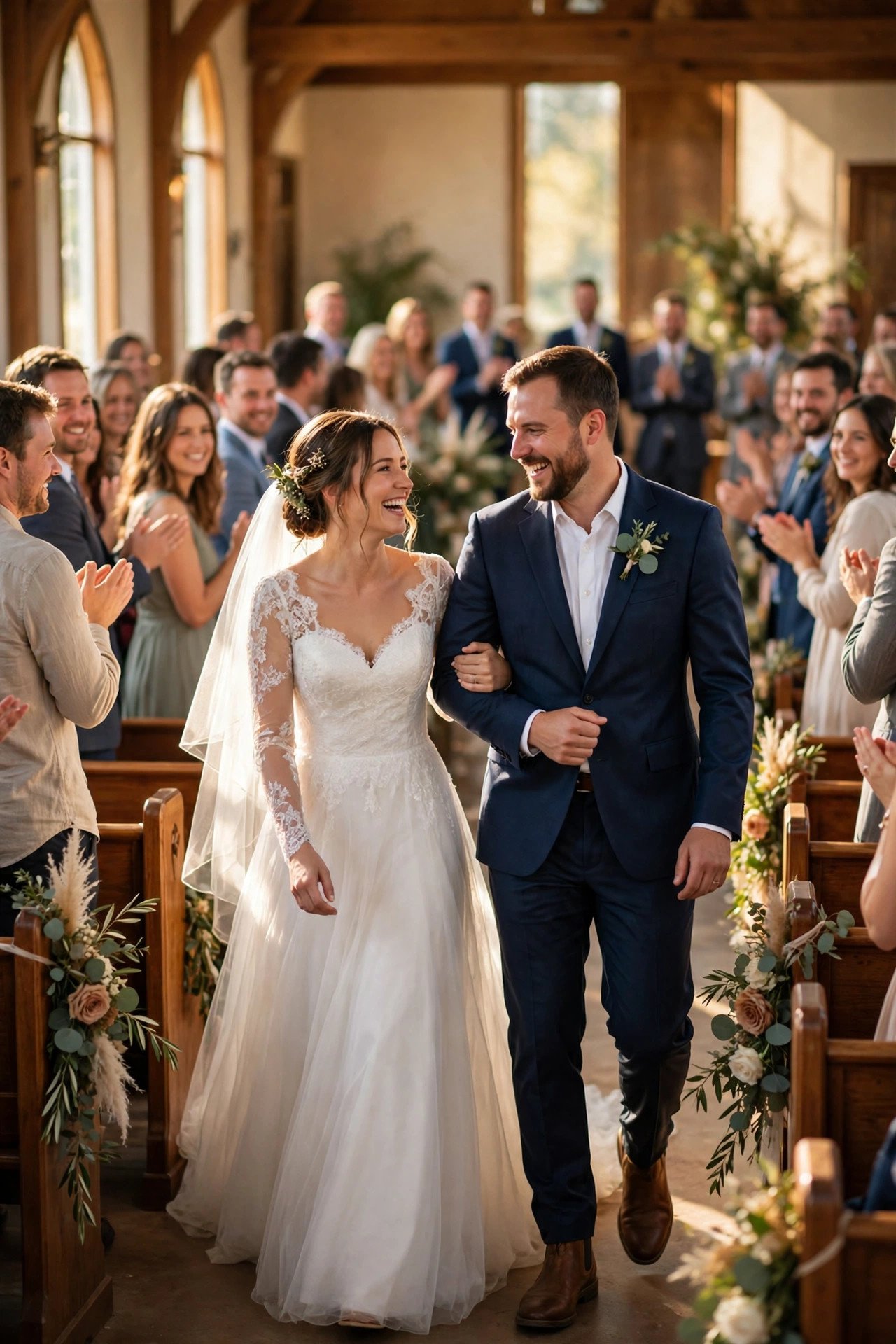
The rite ends with a final blessing and dismissal, and the couple walks back down the aisle married — usually to the ceremony’s biggest music, with the congregation standing, smiling and in many parishes applauding. The wedding party follows in pairs, then parents, then the guests file out to greet the couple at the doors. After weeks of solemn preparation, the recessional is pure release: bells ring in some parishes, petals or bubbles wait outside (rice and confetti follow parish rules — ask), and the celebration’s public half begins at the church steps.
Timing — How Long Everything Takes
 📌 Save
Give guests honest timings: a Nuptial Mass typically runs about sixty minutes; a ceremony with the Liturgy of the Word runs thirty to forty-five. Add the greeting line at the doors, photographs at the church (twenty to thirty minutes if you take them there), and travel to the reception — and publish the shape of it on your wedding website. Guests plan childcare, medication and meals around your ceremony’s length, and Catholic weddings reward the courtesy: the rite is long enough to be an event, and nobody should learn that in a pew with a hungry toddler.
The Rehearsal — Short, Practical, the Night Before
 📌 Save
The parish rehearsal, usually the evening before, is brisk and practical: the coordinator walks the party through processional order, where everyone stands and sits, who carries the rings, where readers read from, and how the couple’s movements flow — no vows are rehearsed aloud (the celebrant prompts those), and the whole thing typically takes thirty to forty-five minutes. Then everyone goes to dinner, which is the rehearsal’s unofficial second half. Bring the readers, the ring-bearers and anyone carrying a cultural item (lasso, coins, veil) — the rehearsal exists precisely for the people with props and positions.
A Ceremony Guests of Every Faith Can Follow
 📌 Save
The kindest object at a Catholic wedding is the order-of-service program: the ceremony’s parts in order, the responses and hymn numbers, when to stand, sit and kneel, who is reading what — and one-line explanations where guests need them (‘Communion: Catholic guests are invited to receive; all are welcome to come forward for a blessing or remain seated in prayer’). With it, a guest who has never entered a Catholic church follows like a parishioner and relaxes into the beauty. Your parish likely has a template; use it, add your names and readings, and print generously.
Catholic Wedding Ceremony FAQs
How long is a Catholic wedding ceremony?+
A wedding celebrated within a Nuptial Mass usually lasts about sixty minutes. A ceremony with the Liturgy of the Word (without the Eucharistic liturgy) typically lasts thirty to forty-five minutes. Your parish can confirm the expected length for your celebration, including music and any cultural additions like the lasso and arras.
Can Catholics marry a non-Catholic in church?+
Yes, with the diocese’s permission or dispensation, which your parish arranges with you. The Catholic partner makes a declaration and promise about continuing the faith and raising future children Catholic, and the other partner is informed of it. The ceremony usually follows the form outside Mass so the whole congregation can participate in every part. Talk to your parish early — this is routine, kind territory for them.
Do we write our own vows?+
In the Catholic rite, the couple exchanges consent using the Church’s approved formulas — personal vows are not substituted, because the sacrament’s promise is made in the Church’s words. Many couples share personal words with each other at the reception, in letters exchanged that morning, or during their first look, where those words shine without changing the rite.
Can non-Catholic guests receive Communion at the wedding Mass?+
Communion in the Catholic Church is reserved to Catholics in communion with the Church. Guests of other faiths are warmly invited to come forward with arms crossed over the chest to receive a blessing, or to remain seated in prayer — both are completely normal at a wedding Mass. One friendly sentence in the program explains this and puts everyone at ease.
How far ahead should we book the church and start Pre-Cana?+
Contact your parish six to twelve months before your hoped-for date — many parishes require at least six months — to reserve the church, meet the priest or deacon, and begin Pre-Cana marriage preparation. Documents such as newly issued baptismal certificates take time to gather, and popular dates fill quickly, so earlier is always easier.
Key Takeaways
- The couple are the sacrament’s ministers: their free exchange of consent is the ceremony’s heart, received by the priest or deacon.
- Choose the form with your parish: Nuptial Mass (about an hour) or the Liturgy of the Word ceremony (30–45 minutes).
- Pre-Cana preparation and parish paperwork start six to twelve months out — book the church before everything else.
- The couple personalizes readings, psalm, intentions, readers and music within the rite’s structure and parish guidelines.
- A printed order of service — with one kind line explaining Communion — makes guests of every faith comfortable and fully present.
Final Thoughts
A Catholic wedding asks a couple to make an enormous promise in ancient words, in front of everyone who matters, and then trusts those words to carry a lifetime. Prepare well — the parish, the Pre-Cana, the paperwork — and then, on the day, let the rite carry you: walk in, listen, consent with your whole heart, and walk out married into a story much larger than your own. It has worked for a great many couples before you.